Feeling trapped indoors? Exercise is one of the best ways to manage cabin fever and protect your mental health. Here’s why it works.
Listen to the episode here…
The Best Way to Beat Cabin Fever (Hint: It’s Exercise)
If you’re working out, it’s one of the best ways to get over cabin fever, to get over mental health issues, to get over feeling kind of blah.
And that’s what I’ve been using exercise for this week.
From Snow Lover to Gym Addict
I grew up in Tampa, Florida. Snow was something you traveled to see. It was a novelty.
Now I’m living in a state where it snows. And there are some days where I absolutely love it. I get excited about being indoors and cozy.
But ever since I got serious about fitness, I can’t stand being indoors. I want to go to the gym as much as I can. It drives me up the wall that I haven’t been able to go.
Yes, I Probably Could Have Gotten There
I know what some of you are probably thinking. I probably could get to the gym if I really tried. I’ve gotten messages from people saying as much.
And the truth is, if I really tried, I probably could.
But I was a little nervous about trying to drive on my roads. I’m looking at sheets of ice. I’ve watched neighbors fishtail right in front of my window.
And because I can work out online, and because I work from home, not having to leave feels like the safer choice right now.
I Really Miss My People
Don’t get me wrong. I’ve really, really wanted to get back to the gym. I miss my girls. I miss the guys. I miss so much about group fitness and working out in person.
Anyone who knows me knows I’m an extrovert. I love to be around people. I get excited by it.
But yeah, I haven’t wanted to put in the risk that would be required to get to the gym. And it sucks.
Working Out Is Keeping Me Sane
I’m really grateful that I’ve had movement this week. I can tell when I’ve been sedentary too long now.
If I go several hours where I haven’t moved or gotten up or started stretching or squatting, I can feel it.
My husband will sometimes even say to me now, “Have you worked out yet?” Because he knows that if I haven’t, that’s when I start getting kind of mean.
I don’t mean to be. I really don’t. But I’m definitely nicer when I’m working out. I’m definitely nicer when I’ve gotten my movement fix for the day.
If You’re Stuck Inside
If you’re stuck at home like I have been and you’re looking for something to give you some good feels, some warm feels, do some movement.
Go on YouTube and find a stretch class or a dance class. There are full body workouts with no equipment. Body weight workouts where you’re using your body as the weight.
I highly recommend it because the truth is, working out is one of the best ways to manage your mental health, your physical health, your emotional health.
It makes me feel more regulated emotionally. It helps with stress. It gives me energy.
Action Items
Don’t underestimate how much exercise helps your mental health
Find a home workout if you’re stuck inside
Move your body even when you don’t feel like leaving the house
Remember that exercise is as much for your mind as your body
Be grateful you can still work out even when you can’t get to the gym
Stuck at home for an entire week? I still worked out every single day. Here’s exactly what I did and how you can do it too.
Listen to the episode here…
I Couldn’t Get to the Gym for a Week – Here’s How I Still Worked Out Every Day
Seven Minutes Away But Couldn’t Get There
I live about seven minutes from the gym. That’s it. But my neighborhood didn’t plow much. My tires were encased in ice. The roads were dangerous.
We got snow, then rain, and it all pooled together and created a very icy situation. My entire street turned into an ice skating rink.
I know because when I came outside to record this, I was slipping and sliding all over the place.
But I Still Worked Out Every Single Day
Just because I haven’t been going to the gym doesn’t mean I haven’t been working out. Every single day, I’ve been moving my body.
On Sunday, I took a Facebook Live class that Rhonda was teaching. It was hard. My husband watched me and said he didn’t think he could do any of those moves. But that’s normal for me now.
Then I did a stretch class.
Walking in Place Classes Are Real
On Monday, I did another stretch class and tried a walking in place class. I’ve been seeing them pop up in my YouTube feed and I was curious.
They say things like “walk a mile in eight minutes” or “get 10,000 steps in an hour.” And I tried a couple of them.
I was actually pretty surprised. I really enjoyed them. The music was great. It was cool to be able to get that much movement in.
The Rest of the Week
Tuesday: Zumba and low-impact cardio and toning. All online. Taught by my favorite instructor Rhonda from videos she recorded during the pandemic.
Wednesday: Another stretch class and another walk in place class.
Thursday: Tabata class online and then another stretch class.
Friday: Zumba, low-impact cardio and toning, and another stretch class.
Every. Single. Day.
The Weights Situation
The only thing that sucks is I have smaller weights at home. I’ve never wanted to invest in dumbbells until now. I have threes and fives.
At the gym, my smalls are eights and my bigs are fifteens. I’ll often use twenties when I can.
So this week, I’ve been holding multiple weights in my hands to get closer to what I normally use. I even added weights to my Zumba routines.
The Mental Health Piece
I’ve been having significant cabin fever. I’ve missed my gym people so much. But working out has been the only real thing keeping some of that at bay.
I’m so grateful I’ve been able to work out because I can tell when I’ve been sedentary too long now. My husband even asks if I’ve worked out yet because he knows I’m nicer when I have.
Exercise is my mental health medication right now.
There’s No Excuse
Though I’ve loved the fact that I can still work out online, there is nothing quite like the magic of working out with people in person in group exercise classes.
But until I can get back there, I’m making it work. And you can too.
Action Items
Stop making excuses about not being able to get to the gym
Find online workout classes you actually enjoy
Work out at home if you have to, but just work out
Remember that consistency matters more than location
Be grateful we live in a time where free online classes exist
Weather keeping you from the gym? Don’t let it derail your progress. Here’s my plan for staying active when Mother Nature has other ideas.
Listen to the episode here
When the Weather Report Says Snow
I’m not snowed in right this second, but the weather reports indicate I will be. And I want to talk about what I plan on doing to keep moving my body even though I might not be able to get to the gym.
I’ve done a similar episode before about how when it’s cold out, people decide not to come to the gym. But what happens when you really can’t?
What’s your plan? What are you going to do to make sure you’re still moving?
The Reality of Being Stuck Inside
On Saturday, I have Zumba. If the roads are bad, which they’re expected to be, there’s a good chance I won’t be able to make it. That’s going to suck.
On Sunday, I normally go for a longer walk as part of my active recovery. And that’s looking like that won’t be possible either because we’re expected to get quite a few inches of snow.
So what’s my plan?
The YouTube Solution
I found this video on YouTube. I think it’s about an hour long. The idea is that while standing pretty much in place, you can get between 7,500 and 10,000 steps in one hour.
That sounds like fun to me. So I’m going to try that out and see how it goes. And I’ll report back after I try it.
The Point of This Episode
The whole point is just to basically say you know, even if you can’t get to the gym, there are things you can do to work out.
Thank God we’re living in a time where all these amazing free classes are available online. I’ve even seen videos on TikTok and Facebook and Instagram.
And if you put them together and basically make a playlist for yourself, you could get 30 to 45 minutes of exercise without having to step inside a gym.
It’s Not As Fun, But It Works
Is it as fun? No. I’m the first to admit that I prefer to be in group classes.
There’s something so special about having people around you that are also trying to do the same thing you’re doing. It feels more like a community effort rather than you’re just sweating alone.
For me, I’m not as excited about working out by myself. But if it still keeps me moving, it’s worth it.
My Smaller Weights Problem
The only thing I will say is it kind of sucks that I have smaller weights at home. I’ve never wanted to invest in dumbbells until now. And I hope I won’t ever need them again.
I have a set of threes and I have a set of fives. I’ve been actually trying to hold them together to get closer to what I normally use at the gym.
In previous episodes, I’ve talked about how my smalls are eights and my bigs are fifteens. I’ll often use twenties whenever I can or whenever I feel like I’m able to.
But this past week of only being able to use threes and fives has been weird. So I’ve actually been adding in extra reps.
Adding Weights to Zumba
One of the things I did on Saturday is I actually added weights to my Zumba routines. The Zumba class I was taking online, I added the threes to it. I was using the threes for a lot of the dances.
Helped a lot because I was still putting in a bunch of reps and still getting the good feels that I was hoping for to continue feeling like I’m actually working my body.
And I can tell you that even though I’ve been using smaller weights, I am still feeling the feels. Like I’m feeling like I’m actually working and moving my body. And that was the goal.
The Mental Health Aspect
I’ve been having some pretty significant cabin fever, especially since I’ve missed my gym people so much.
The more we can move our bodies, even when it’s cold, the better.
Make Your Playlist
I’ll leave some links in the show notes to these videos because the more we can move our bodies, even when it’s cold, the better.
That’s kind of what I plan on doing, even though I plan on being snowed in.
I hope that I’m not. I hope that I can somehow get to the gym anyway. But I have to be realistic and just accept that Mother Nature’s going to do her thing.
And if she’s going to do her thing, well, I’m still going to do my thing, even though I would prefer to be at the gym.
No Excuses in the Internet Age
The reality is you should not have an excuse in this day and age. If you have access to the internet, you have access to classes.
On Tuesdays and Thursdays, what I used to do is if I could not do the Mat Pilates class, I would do a standing Pilates class on YouTube.
I have to tell you, I have been taking fitness classes on YouTube for the better part of the last three months. I’m taking them on Wednesdays and Sundays. I’m mainly taking the stretch classes and they have been amazing.
I can’t even explain to you how wonderful it has been to be able to move my body even whenever I cannot get to the gym.
The Bottom Line
I got to do what I got to do and continue moving because that is definitely my goal. Just to keep moving.
Because I’ve said it a bajillion times at this point, it just feels so much better than what I used to do.
That sedentary lifestyle? I never want to go back. I just don’t.
What I Hope You’ll Do
I hope that you will take this advice that even if you are snowed in or if you can’t get to the gym, that you do something to move your body today.
It doesn’t have to be intense. It doesn’t have to be crazy. It just has to be movement.
Action Items
Create a playlist of free online workout videos before bad weather hits
Bookmark YouTube channels with workouts you enjoy
Keep light weights at home for adding resistance to cardio
Find at-home alternatives to your regular gym routine
Remember that movement is movement, even if it’s not at the gym
Try the “walking in place” videos for step counts
Use bad weather days for active recovery activities like stretching
Four pant sizes in six months. Not through crash dieting or punishment workouts, but through consistent movement and listening to my body. Here’s why the scale isn’t telling the whole story.
Listen to the episode here
The Fitting Room Moment That Made Me Cry
I needed new pants. The ones I started wearing back in July were so big I was using what basically amounted to a rope belt just to keep them up. Enough was enough.
I grabbed a pair that I thought would be too small. Something told me to just try them on, see how tight they were. And when I tell you those pants slid on so easily that I looked in the mirror and started crying tears of joy, I mean it.
I jumped up and down. I was so excited. Holy cow.
Since July 14th, 2025, I’ve dropped four pant sizes. Four. That’s nuts to me.
The Goal I Didn’t Expect to Hit This Fast
My goal was to get into the pant size I’m in now. I’m shocked as hell that I did it this quickly. Like, truly. I didn’t expect to get down to the size I am now as fast as I did.
I know I’ve been working really hard and all that jazz, but I literally was in awe. I’m still in awe.
I’ve looked at my pants a few times today, making sure they actually fit. Am I okay? Am I going to rip my pants? But no, they actually fit.
And it is the best feeling.
When the Scale Doesn’t Tell the Whole Story
Here’s the thing. The scale hasn’t changed to the degree I was hoping it would. But I’m told it’s because muscle weighs more than fat. And that’s probably one of the big factors contributing to the fact that I’m nowhere near the weight I wanted to be.
But I guess it’s true that as long as your pants fit better and you’re getting into the size you wanted, gains are happening. Good things are happening.
So I’m tickled pink. And I wanted to share this milestone because it just feels so good.
It’s Not About Weight Loss Anymore
I’m not going to call them weight loss goals anymore. I’m going to call them fitness goals because that’s what they really are.
Even though I’m not dropping weight, I am gaining muscle and I am losing inches. And oh God, it just feels so good.
I want more of this. I’m going to keep going. Like I said in a previous episode, I’m going to ride this wave as long as I possibly can.
The Pain That’s Worth It
Yes, I’m in pain today. I actually hurt my shoulder. But the pain I’m feeling is absolutely worth it. It’s so much better than the pain I was feeling before of just existing.
I wanted to share this because I said I was going to be raw and real and transparent. So this is my victory lap of holy crap, I’m down four sizes.
And I kind of want to get down one more size. This was my goal size, but you know what? Let’s keep going. Let’s have some fun.
For the First Time, It Feels Possible
If I can get down one more size, that would be phenomenal. I would be absolutely blown away.
And for the first time in my life, that actually feels possible. I did not ever think I would say that.
But if I keep going at the rate I’m going and keep working the way I’m working, I think it’s actually possible.
The Diet Secret (There Isn’t One)
I’ll say it again. I’m not really changing my diet very much. I’m still eating pretty much everything I was always eating.
I will admit it’s smaller portions than it was, because I literally cannot eat more than I am. And I think that’s just because I’m really listening to my body now. I’m not just stuffing myself the way I used to.
I’m paying attention as I’m eating and mindfully eating, but I’m not changing what I’m eating.
The Real Changes
Yes, I have changed my beverages just a little bit. I’m reaching for water more than I ever have in my whole life. So I am cutting way back on soda, way back on juices and other beverages. Water is the main thing I reach for.
But other than that, the only thing that is really a dramatic change in my life is how much I’m moving my body.
I love how much I’m moving my body. I’m really looking forward to tomorrow at Zumba. I’m hoping my shoulder will feel better by then. But even if it’s not, I’m going to show up. I’m going to keep going.
How I’m Feeling Beyond the Pants
It’s not just about the scale. It’s not just about how I’m looking. It’s how I’m feeling.
I’m feeling so much better than I was six months ago. I have more energy. I’m sleeping a little bit better. Any sleep I’m struggling with, that’s my own stress, my own issues. But the exercises have been helping with the whole stress thing.
And it’s been helping me in so many ways.
I’m down four pant sizes and I’m down 26 pounds and I have no plans on stopping anytime soon.
This Wasn’t a Challenge
As I told you when I first started this podcast, this was not a challenge. Yes, everything I’m doing is challenging, but I didn’t sign up to do a challenge.
This wasn’t a 30-day challenge. This wasn’t a zero to 5K challenge or 30 planks in 30 days or any of those things.
For me, this was not a challenge. This was about trying to implement a change in my lifestyle. And that is what I have done. And that is what I am so excited about.
Why This Matters
When you look in the mirror, I’m still seeing the fatty. I do. I still see the fatty. But I’m trying to recognize that my pants are fitting better.
I’m trying to pay attention to the changes I can’t necessarily see but that I can feel. And that’s helping me.
I’m focusing more on the inches and the pant sizes. Because when I look in the mirror, I’m still seeing the fatty, but I’m going to keep showing up because now I’m addicted.
Now it’s a lifestyle change. Now it’s something where I am a fitness person. That feels really fun to say.
Action Items
Measure your progress by more than just the scale
Take note of how your clothes fit
Pay attention to energy levels and how daily tasks feel
Celebrate non-scale victories like increased strength and endurance
Focus on fitness goals rather than just weight loss goals
How to Measure True Worth: 6 Value Dimensions That Matter More Than Price
When we shop, invest, or choose a service, the first thing we notice is the price. Yet true value often lies in hidden corners, such as emotional connections, ethical alignment, timing, and long-term impact.
Recognizing value beyond the sticker price helps you make smarter decisions, build stronger relationships, and create lasting benefits for yourself or your organization. This broader view of value beyond cost guides you toward better outcomes and stronger ROI.
In this article, you will learn how to:
Compare price to real market worth
Tap into emotional and psychological drivers of purchase
Align purchases with personal and corporate ethics
See how context and timing reshape value
Leverage compounding effects for sustainable growth
Measure and communicate intangible returns
By the end, you’ll have a clear framework for evaluating any good, service, or opportunity, not just based on what you pay today but on the total worth it delivers over time.
Let’s begin by examining how supply and demand shape economic value in our first section: Economic Value: Price Versus Worth.
1. Economic Value: Price Versus Worth
Financial value refers to the monetary measure of a good or service based on the balance between cost and benefit. At its core, value emerges from supply and demand. When demand rises or supply falls, prices tend to increase. When demand drops or supply increases, prices decline. But the sticker price may not reflect true market worth or intrinsic value.
The gap between price and real value influences buying decisions and portfolio management.
Market dynamics and price fluctuations
Supply and demand basics
Supply represents the quantity of an item available. Demand measures how many people want it. As these forces interact, they set the market price. A limited supply facing strong demand pushes prices up. Conversely, an oversupply with weak demand pushes prices down.
Real-world price volatility
Prices fluctuate over time as factors like economic growth, interest rates, and consumer sentiment shift. Seasonal trends in agriculture, housing market cycles, or changes in production costs all contribute to price volatility. By tracking these patterns, buyers and investors can spot opportunities to acquire assets below future market values.
Real estate vs stock markets
Comparing real estate and stock markets highlights different aspects of price versus worth. Each asset class shows how market forces and expectations shape value beyond the sticker price.
Real estate examples
In real estate, local supply constraints and buyer sentiment play a key role. In a desirable neighborhood, limited housing stock can inflate prices well above construction costs. When new developments arrive or interest rates change, property prices may adjust downward. Understanding these local dynamics helps investors assess true market value.
Stock market examples
Stock prices reflect expectations of future performance. A high-growth company may trade at a premium compared to its book value. Conversely, an unexpected earnings miss or industry slowdown can trigger a rapid price correction. Investors who understand this dynamic can distinguish between short-term price swings and long-term value creation.
Understanding the difference between price and worth lets buyers and investors make informed decisions. Recognizing how market forces shape economic value guides you to seek assets that offer true value beyond cost. For some investors, diversifying into assets such as a gold IRA helps hedge against market volatility and preserve long-term purchasing power.
2. Emotional & Psychological Value
Beyond financial value, emotional and psychological factors often determine how we perceive worth. Emotional value drivers influence purchase decisions and build deeper loyalty. This section explores sentimental connections and experiential returns, two key elements of a product’s value proposition beyond its functional purpose.
Sentimental items & heirlooms
Sentimental items create a unique value proposition rooted in personal memory and attachment. A family heirloom triggers nostalgia and a sense of continuity across generations. Consumers may pay a premium for objects with strong personal associations, even when equal alternatives exist. This emotional attachment can far exceed any market price.
Experiential purchases & customer loyalty
Experiences such as travel, concerts, or workshops offer an experience-based value proposition that engages customers beyond mere utility. They deliver intangible rewards and lasting memories. Over time, consumers who value experiences tend to become advocates, referring friends and boosting brand loyalty.
Building emotional ROI
Memorable service moments raise customer satisfaction.
Brands that focus on emotional value creation can generate higher lifetime value and deeper customer loyalty.
3. Intrinsic & Ethical Value
Intrinsic and ethical value define the core value proposition that resonates with personal and corporate identities. These factors build long-term trust and differentiate brands in a crowded market.
Personal values & decision-making
Buyers often consider:
Authenticity: Does the brand match its values?
Purpose fit: Does it support causes they care about?
Long-term impact: Will it deliver lasting benefits?
For example, when selecting clothes, consumers may favor brands committed to fair labor practices and sustainable sourcing. This ethical alignment drives repeat business, referrals, and community engagement.
Corporate ethics & brand reputation
Corporate ethics programs and clear purpose statements set responsible firms apart. They help businesses build stakeholder trust, anticipate social or regulatory changes, and reduce risk. They also command a premium price based on ethical value.
Ethics-driven branding
Brands that integrate sustainability, fair labor, or social justice into their mission cultivate a dedicated audience. Many publish annual impact reports and embed ethical sourcing across their supply chain.
Reputation resilience
When ethical challenges arise, a strong values foundation speeds recovery. Demonstrated integrity rebuilds stakeholder confidence faster than approaches focused solely on profit.
Focusing on intrinsic and ethical value helps create durable relationships and enhances brand reputation.
4. Contextual & Situational Value
Value often depends on where and when it applies, shaping the situational value proposition of a resource. Contextual factors can dramatically shift a resource’s worth. This section presents two examples that illustrate this dynamic.
Sports analytics: performance metrics
In sports, the same stat can have a different value based on the game situation. Metrics like Win Probability Added (WPA) in baseball or Player Efficiency Rating (PER) in basketball quantify contributions in context. A three-pointer in a close game adds more WPA than the same shot in a blowout. A relief pitcher’s leverage index shows the importance of high-stress innings. These situational metrics reveal hidden value and guide smarter decisions by coaches and analysts.
Specialized fields: situational appraisal
In niche industries, context can change equipment value radically.
Oil exploration equipment
A drilling rig’s worth spikes when oil prices climb, or reserves lie in challenging terrain. Mobility, depth capacity, and safety features earn a premium in remote locations.
Custom medical devices
In surgery, a patient-specific implant may cost more than a standard device, yet it delivers higher success rates and faster recovery. The situational need for precision justifies this higher price.
By reviewing case studies across industries, we see how context and timing transform basic inputs into strategic value.
5. Compounding & Long-Term Value Creation
Creating sustainable value that endures is like earning compound interest, with each action contributing to a compounding value proposition. Small, consistent efforts build relational capital that grows into durable worth.
Compound Interest & Relational Trust
Trust builds slowly but gains momentum over time. Brands such as Unilever invest decades in marketing and purpose to command a premium. Software firms like Nedap raise prices by 5% to 7% annually while keeping customer retention above 95%. Platforms such as Rightmove leverage network effects so each new user adds value to the entire community.
Renewal Practices for Sustained Worth
Long-term compounding needs a clear playbook. Bain’s Profit From the Core framework highlights how focused actions on core strengths renew value. Five key building blocks guide renewal:
Market and portfolio choices
Distinctive assets and leadership positions
Repeatable business models
Financial strategy that balances reinvestment and payouts
Continuous measurement of core performance
These elements reinforce each other and ensure that value compounds across economic cycles.
6. Measuring & Communicating Intangible Value
Translating subtle gains into memorable narratives requires clear frameworks that highlight the intangible value proposition. Combining storytelling with data visualization helps you communicate intangible value and reinforce strategic goals.
Qualitative storytelling techniques
Stories connect stakeholders to nonfinancial outcomes. Narrative case studies show why a project matters and how it impacts people. Use firsthand accounts to illustrate emotional or social value. These techniques build empathy and trust within teams and with clients.
Developing narrative case studies
Define clear objectives and context.
Include authentic user quotes and before-and-after snapshots.
Highlight qualitative outcomes, such as satisfaction, reputation, and knowledge gained.
Data visualization & value metrics
Data dashboards make intangible impact clear with visuals. By aligning metrics with strategic goals, dashboards guide decision-making. Integrate real-time data feeds to keep information current. For example, companies that invest in advanced media and streaming solutions such as Dolby.io, which enhances audio-visual clarity and immersion, often see higher engagement, stronger message retention, and more effective communication of intangible value across digital experiences.
Designing intuitive dashboards
Select metrics that reflect social, emotional, or environmental ROI.
Use line charts and heat maps to illustrate trends.
Apply consistent color schemes and annotations to highlight milestones.
By weaving storytelling together with data, you can create a comprehensive picture of intangible returns and strategic value.
Conclusion
Understanding value beyond the price tag gives you a richer perspective on every decision. By looking past the sticker price, you uncover benefits that drive long-term success, strengthen relationships, and uphold core principles.
Compare price to real market worth to spot underpriced or overpriced options
Tap into emotional and psychological drivers for deeper customer loyalty and satisfaction
Align purchases and partnerships with personal and corporate ethics for lasting trust
Factor in context and timing to identify strategic advantages in any situation
Leverage compounding effects through consistent, value-focused actions over time
Measure and communicate intangible returns with stories and clear metrics
Armed with this framework, you can make smarter choices and build lasting value in your personal or professional life. Next time you face a buying or investment decision, pause and ask: What do you truly gain beyond the cost? Value lives beyond the sticker price, so seek it to unlock stronger outcomes every time.
About the Author – Ellie Williams
Ellie Williams studied at Miami State University and majored in Marketing with a minor in creative writing . She enjoys doing freelance writing on general business, wellness, and lifestyle tips. During her free time she enjoys catching up with friends and family or attending local events.
If we’re all going to die anyway, shouldn’t we be as healthy as possible while we’re here? How mortality became my biggest fitness motivator.
Listen to the episode here…
Why Thinking About Death Finally Got Me in Shape
Mortality has been on my mind lately. I’ve had some losses. I’ve been having those existential moments where you wonder what we’re all doing here and what the point is.
And it hit me. Just six months ago, I wasn’t really living. I was surviving.
I was so out of shape that existing hurt. Getting up from a chair was painful. Walking to the bathroom was uncomfortable. I was just getting through the day instead of actually living it.
If We’re Going to Die Anyway
Here’s my message. If we’re all going to die eventually, shouldn’t we do everything we can to be as healthy as possible while we’re still here?
Shouldn’t we take care of ourselves so we don’t become a burden on others? So we don’t need help with basic tasks? So we can actually enjoy the time we have?
I felt like if I had kept going the way I was, I would have had a heart attack in just a few years. My doctor called me a ticking time bomb. That’s not an exaggeration.
Normal Blood Pressure for the First Time
I went to the doctor recently for something else. And she told me that for the first time in as long as I can remember, my blood pressure was normal.
Normal. That’s huge for me.
Six months ago, everything hurt. Just existing was painful. And I’m not exaggerating when I say that. Getting up from my chair hurt. Walking hurt. Standing hurt.
But the pain I feel now from working out is so much better than the pain I felt from just existing.
Choose Your Pain
You’re going to hurt either way. Your body is going to require something from you.
It’s either going to require the effort of sweat and discomfort now, or it’s going to require medications and doctor visits and limitations later.
I’d rather hurt from working my body than let it break down from sitting in a chair.
The hurt of neglect lasts forever. The hurt of exercise is temporary and gets easier.
Making My Body Last
With the years I have left, I want to make my body as fit as possible so I can handle those years. So I can feel strong. So I’m not worried about heart attacks or high blood pressure or needing medication.
I don’t want to just survive anymore. I want to live.
And I want that for you too.
Action Items
Think about your future self 10 years from now
Consider what your body will need from you either way
Choose the temporary discomfort of exercise over permanent decline
Make one healthy choice today that your future self will thank you for
Remember that taking care of yourself now is taking care of yourself later
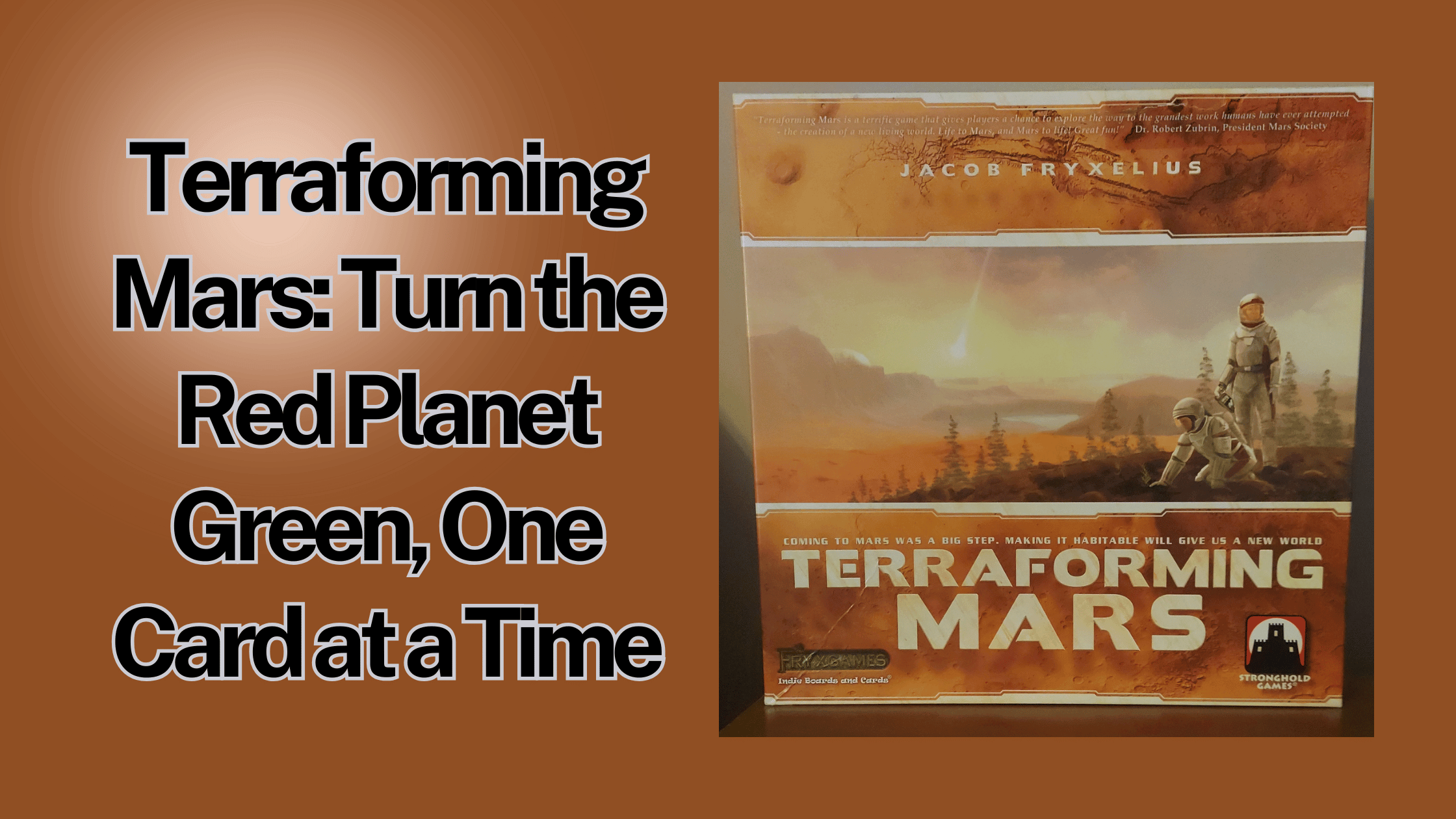
Raise oxygen levels, warm the planet, and fill the surface with oceans while outpacing rival corporations. My review of the deep strategy game Terraforming Mars.
Players: 1-5 | Time: 2-3 hours | Age: 12+ | My Rating: 4.5 out of 5 cupcakes
What Is Terraforming Mars?
Terraforming Mars is a strategy game where you play as a corporation competing to make Mars habitable for human life. You’re not fighting anyone. You’re not building armies. You’re raising oxygen levels, warming up the planet, and filling the surface with oceans. And somehow, it’s one of the most engaging games I’ve ever played.
It plays 1 to 5 players and usually takes 2 to 3 hours. There’s even a solo mode where you race against yourself to complete the terraforming before time runs out.
How You Terraform Mars
The game tracks three global conditions: oxygen level, temperature, and ocean coverage. The game ends when all three hit their target numbers. Every time you raise one of those conditions, your Terraform Rating goes up, which both earns you victory points and increases your income.
You raise those conditions by playing project cards. Each card represents a technology, building project, or scientific breakthrough. Some cards place city tiles or greenery tiles on the Mars map. Others give you resources, let you take special actions, or provide ongoing benefits.
The Engine Building Is Everything
Over the course of the game, you build an engine of resource production and card combos. Maybe you’re specializing in plants and cities. Maybe you’re going heavy on science and tech tags to unlock powerful cards. Maybe you’re playing an energy-focused corporation that powers everything else.
Each corporation you start with comes with a unique ability and starting hand, which sets the tone for your strategy from the very beginning.
Hundreds of Unique Cards
The base game comes with over 200 project cards, and almost every card is unique. Finding unexpected combos between cards is one of the most satisfying things about Terraforming Mars. No two games play the same because you’re never drawing the same hand twice.
It’s a Longer Game
I’d be doing you a disservice if I didn’t mention that this game runs longer than most. Plan for at least two hours, probably more with new players. But for the people who love heavy strategy games, those hours fly by. This is a game that rewards your full attention.
Do I Recommend It?
Yes, for strategic thinkers who enjoy building systems and watching them pay off. Terraforming Mars has real depth, excellent replayability, and a theme that actually makes the mechanics feel meaningful. If you’re willing to invest the time, it pays off beautifully.
My Rating: 4.5 out of 5 Cupcakes
A deeply satisfying strategy game with a brilliant theme and near-endless replay value. Highly recommended for patient, strategic players. And no, I’m not just saying this because I won the first time we played! Though, admittedly, that did help me enjoy it more. Haha!
Working out 8-15 hours a week has people asking if I’m overdoing it. Here’s what the science actually says about exercise frequency and when it’s too much.
Listen to the episode here…
People Keep Asking If I’m Overdoing It
People have been asking me lately if I’m working out too much. They see me posting about my workouts throughout the week and they wonder if I’m overdoing it.
So I decided to dig into the science and find out what’s actually recommended.
What the Guidelines Say
Adults need a minimum of 2.5 hours (150 minutes) per week of moderate intensity aerobic activity. That breaks down to about 30 minutes a day, five days a week.
Alternatively, you can do 75 minutes of vigorous intensity activity like running instead of brisk walking.
On top of that, you also need muscle strengthening activities two or more days a week. These need to work all your major muscle groups. And these sessions aren’t supposed to count toward your 150 minutes of aerobic activity.
How Much Am I Actually Working Out?
I’ve been working out a lot more than the minimum. I’ve been working out as little as eight hours a week and as much as 15 hours a week.
Yeah, that’s way more than 30 minutes a day.
But is that bad for me?
What the Research Shows
Research shows that doubling up to 300 minutes per week (about five hours of moderate intensity activity) provides additional health benefits. This is where you start seeing substantial improvements in cardiovascular health, weight management, and disease prevention.
And I’m doing even more than five hours.
There’s No Universal “Too Much”
The big thing I kept finding is that there’s no universal “too much” as long as you’re making sure you’re getting plenty of nutrients and recovery time.
I’m not going to deny that I sometimes have a little bit of fatigue. I get tired. So I’ll use smaller weights sometimes.
But there’s nothing I found that says I’m working out too much. There’s no hard science saying this is harmful.
Athletes work out 10 to 20 hours a week and they’re fine.
Listening to My Body
As long as I’m not hurting myself, as long as I’m not feeling too fatigued, is there anything wrong with working out as much as I am?
I personally don’t think so.
It wouldn’t surprise me if I continue getting questions about whether I’m working out too much. Maybe I am. I’m not really sure.
This Season of Life
But right now in my current season of life, I am loving how much I’m working out.
Yes, I’m hurting sometimes. Yes, I’m feeling the pain sometimes.
But after so many years of a sedentary lifestyle, after so many years of not moving my body, I’m going to just ride this wave as long as I can stand it.
The Alternative Was Worse
Yes, there may come a point where I feel like I need to lower the amount of exercise I’m doing in a week. There may come a point where I feel like I am moving too much.
But right now, I’m going to keep riding this wave and enjoying as many workouts as I can get in.
I sat still for nearly two decades. I was barely active. I was packing on the weight and not doing anything about it.
When you do that and then you have your light bulb moment where you’re like “it’s time to make a change,” yeah, you might go a little extreme.
Finding What Works for Me
For me, it just feels like the right thing to do right now. I want to keep enjoying it.
Yes, I’m going to do everything I can to make sure I don’t get injured. I’m going to do everything I can to make sure I’m recovering properly and taking care of myself.
But I would rather do what I’m doing right now and continue doing it the way that I am because it’s so much better than the alternative.
More Energy Than Ever
I was just having this conversation yesterday. In the past six months, I have had more energy than I have in at least the last six years.
That’s worth a lot.
Action Items
Don’t let other people’s opinions dictate your workout schedule
Research what the actual guidelines are for exercise
Listen to your own body, not just general advice
Remember that more than the minimum can provide additional benefits
Focus on how you feel, not just what the numbers say
Make sure you’re recovering properly and getting enough nutrients
Adjust when your body tells you to, not when others say you should
Modern sports medicine has flipped the old advice about resting when injured. Here’s what actually helps you heal faster, plus the modifications to keep training safely.
Listen to the episode here…
Rest Isn’t Always the Answer
Someone sent in a question that deserved its own episode. What do you do when you still want to work out but you have an injury?
This is timely for me because I actually dealt with a pretty painful injury recently. I bruised my tailbone.
Let me tell you, that was brutal. The most painful situation I’ve dealt with in a while.
And the entire time I had that injury, I did one thing over and over. I modified. Modified. Modified.
That’s my best answer. But I wanted to give you more than just that, so I did some research.
The Old Advice Is Wrong
Let’s bust a big myth first. Rest is not always the complete answer to dealing with an injury.
According to Yale Medicine, the old recommendation to avoid all activity has changed. Today’s approach is called load management. It focuses on protecting the injured area while still incorporating appropriate movement.
Johns Hopkins Medicine emphasizes that exercise actually helps your healing process. You just need to protect the injured area while keeping the rest of your body moving.
Think about it this way. If you have a shoulder injury, your legs don’t need a vacation.
Maybe you’re not moving your arm as much. But you’re still doing all the other movements. Your body can handle that.
The RICE Method Still Works (For the First Few Days)
For acute injuries like sprains or strains, Cleveland Clinic still recommends the RICE method for the first 48 to 72 hours.
Rest. Ice. Compression. Elevation.
But here’s what a lot of people don’t talk about. After those first few days, gentle movement actually becomes your friend.
Harvard Health notes that after the initial rest period, appropriate movement helps healing. WebMD says if pain and swelling haven’t improved in five to seven days, you might need to see a doctor.
But if you just have a sprain or strain, after 48 to 72 hours you might actually want to start reincorporating movement.
Four Key Modifications for Training With an Injury
If you have an injury but still want to get your workouts in, there are four modifications you can use.
Modification One: Reduce Your Load
Lower the weight. I do this all the time.
Anytime I feel like I’m risking an injury or I’ve already hurt myself, I go lighter. When I wasn’t feeling well, I dropped from eights and fifteens down to fives and tens.
You’re still getting the reps in. You’re still training. You’re just not working quite as hard. And that gives your body a chance to recover while you’re still moving.
Modification Two: Limit Your Range of Motion
Physical therapy research shows that most pain occurs at the end ranges of movement.
If squats hurt at the bottom, try box squats to three-quarters depth. You’re still training. You’re still getting the movement pattern in. But you’re not aggravating your injury.
Modification Three: Adjust Your Tempo
Slow down movements instead of having those explosive forces on your tissues.
According to rehabilitation specialists, this also improves your form and muscle memory. If fast movements hurt, slow them down.
Modification Four: Change the Exercise
You need to understand what you’re training, not just the exercise itself.
If you can’t do back squats, try split squats or lunges or step-ups. They train the same muscle groups and movement patterns. But they’re not aggravating your injury as much.
If you can’t do overhead presses, try landmine presses or incline pressing variations.
The point is to work the same muscles in a different way.
Tell Your Instructor
If you’re working out with someone, tell them about your injury. If you have an instructor or personal trainer, they should be qualified enough to give you modifications.
There’s one woman in my classes who can’t get down and do plank jacks. During plank jacks, the instructor tells her to do wall sits instead.
If I can’t do my squats, she’ll tell me to do a wall sit or some other exercise that still works those same muscle groups without making my injury worse.
It doesn’t mean you can’t keep working out. It just means you need to modify what you’re doing.
Movement Supports Healing
Here’s what the research shows. Maintaining appropriate physical activity during recovery actually supports your healing.
It improves blood flow. It helps you maintain muscle function. It keeps you from losing all your progress while you heal.
The key is to train around your injury, not through it.
Modification isn’t weakness. It’s smart training. Your goal during injury recovery is to maintain your gains while creating the best environment for healing.
When to Get Professional Help
When in doubt, consult your instructor, personal trainer, or physical therapist. They can create an individualized program based on your specific injury.
If pain isn’t improving after five to seven days, see a doctor. If it’s getting worse, see a doctor. If you’re not sure whether you should be working out at all, ask a professional.
But for most minor injuries, appropriate modification lets you keep training safely.
My Tailbone Experience
When I bruised my tailbone, I modified everything that put pressure on that area. Anything that required me to sit directly on it got changed.
I did more standing exercises. More wall work. More modified versions of floor exercises.
It sucked. But I still got my workouts in. And by modifying instead of stopping completely, I maintained my routine and my momentum.
That’s what matters. Stay active. Train smart. Give your body what it needs to heal.
Action Items
For acute injuries, use RICE for the first 48-72 hours
After initial rest, start incorporating gentle movement
Use the four modifications: reduce load, limit range of motion, adjust tempo, change exercises
Tell your instructor or trainer about any injuries so they can provide modifications
See a doctor if pain doesn’t improve in 5-7 days or gets worse
Only have time for 3 workouts? Ashley shares how to structure them, reveals the surprising class she craves, and shares the moment everything clicked.
Listen to the episode here…
You Asked. I’m Answering.
You guys sent in some really great questions. And instead of giving you quick, surface-level answers, I wanted to take my time with these. Because these are the real questions people have when they’re starting or restarting their fitness routine.
So let’s get into it.
Three Workouts a Week: How to Get the Most From Your Time
Someone asked what they should do if they can only commit to three workouts per week. How do you structure that for maximum results?
Here’s what I’d do.
Choose workouts that hit your whole body. Don’t waste your limited time on programs that only work one or two muscle groups. You need full-body sessions.
That’s why I love low impact cardio and toning, plus Tabata. In those classes, we work everything. Every single body part gets attention. If I could only work out three times a week, I’d do two low impact cardio and toning sessions and one Tabata.
Now, maybe you can’t get to those specific classes. That’s fine. YouTube has tons of full-body workout videos. Some need no equipment. Some just need dumbbells. Some use resistance bands.
The key? Make sure at least one of your three workouts includes lifting. And before you roll your eyes, let me tell you why.
Why Weightlifting Actually Matters
I used to think dumbbells weren’t that important. Just another thing fitness people pushed for no real reason.
I was wrong.
When I started actually lifting weights regularly, I felt the difference. Your body responds to resistance training in ways that cardio alone just can’t replicate. You get stronger. Your metabolism changes. Your workouts improve across the board.
So if you’re only working out three times a week, make one of those sessions a strength day. Even if it’s just bodyweight exercises or light dumbbells. Do something that challenges your muscles.
My Current Training Week
Someone else asked what my typical week looks like right now.
Mondays I do Zumba and low impact cardio. Tuesdays are low impact cardio plus abs and booty work. Wednesdays are my rest days, but I mean active rest. I’m stretching and walking. Not sitting on the couch all day.
Thursdays I do Tabata and another stretch class. Fridays and Saturdays are Zumba and low impact cardio and toning again.
This week looks different because my favorite instructor has been covering extra classes. And yeah, I’ve been taking advantage of that. But the schedule I just described is my normal routine.
The Moment Everything Changed
Here’s a question I loved. How has your approach to fitness changed over the past few months, and what made you shift your thinking?
The honest answer? It was a lightbulb moment.
On July 14th, my instructor Rhonda said something to me. “Everyone is busy, but it’s a choice.”
I’d heard her say variations of that before. But for some reason, that day it clicked. I’d been working out off and on for over a year and a half at that point. Always finding reasons why I couldn’t fully commit. Always busy with something else.
But the truth was, I wasn’t doing what I needed to do to make the changes I wanted to make.
When Rhonda said that and it finally hit me, I heard it. Really heard it. And I made the decision right then to change.
That’s what shifted my thinking. I drew my line in the sand.
If You’re Thinking About Starting
If you’re considering starting a fitness routine, really examine your life first. Look at what your current life actually looks like. What’s going on? What’s taking up your time and energy?
Then make the decision. For yourself. Not for anyone else.
When you show up for yourself and commit to doing this for you, everything shifts. But here’s the thing. You have to keep making that decision over and over until it becomes a habit. Until it becomes something you just do without thinking about it.
Then you keep going.
The Biggest Mistake People Make
What’s the most common mistake you see people making when they first start their fitness routine?
Not committing.
If you say you’re going to start working out and then the very next day you don’t show up, you’re not all in. You haven’t actually committed.
I had to learn this about myself. Sure, I said I was going to work out. But until I got serious enough to put it in my calendar, to make a plan every single week, to actually show up every single week, I wasn’t really committed.
Some people will tell you the biggest mistake is going too hard too fast. And yeah, that can be a problem. But in my opinion, the bigger issue is people not actually committing in the first place.
If you’re serious, commit and show up. That’s it.
From Dreading It to Craving It
Someone asked what physical activity I used to dread but now actually look forward to.
Tabata.
I cannot believe I’m saying this. I used to absolutely dread Tabata. I didn’t understand why so many people said it was their favorite. It felt too intense. Too hard. Too much.
But now? I actually look forward to it.
One of the women I work out with explained why Tabata is her favorite. Because it works your whole body, she feels like she gets the most value out of her workout effort compared to any other class.
And I get that now. I really do.
Don’t get me wrong. Zumba is still my favorite. That’s the hill I’ll die on. I’ve loved Zumba forever. Even back when I lived in Tampa, it was always the class I tried to attend because I love to dance.
But in terms of actual physical training and real results? Tabata has become my go-to. I love that low impact cardio and toning includes some Tabata rounds too.
The fact that I now look forward to something I used to dread shows how much has changed.
The Twenty Pound Dumbbells
Last question. Someone asked when I’ll finally pick up those twenty-pound dumbbells that have been haunting me.
Here’s the truth. I am using the twenties occasionally now. I’m just not fully committed to using them every single time yet.
My goal is to be using the tens and twenties as my regular weights within the next month or so. Tens for my light weight. Twenties for my heavy.
But if I don’t feel strong enough, I won’t push it. There have been a couple of classes recently where I wasn’t feeling well and I went back down to the fives and tens. I just couldn’t handle the fifteens those days.
And apparently that’s normal. There will be days when you feel weaker. Days when the heavy weights just aren’t happening.
My plan is to be reaching for the tens and twenties by March. That’s my goal.
Why I’m Doing This
I don’t want these episodes to be too long. But I really appreciate you guys sending in questions. Thank you.
Keep sending them. I’d love to do more of these where I’m just being honest about what I’m experiencing and what I’m going through.
One thing I see too often with fitness podcasts is people just cramming information down your throat. All the reasons you need to be working out. And yes, those things are true.
But what inspires me? What gets me excited? Hearing real accounts of what people are actually going through.
When more people talk about the truth, the better. So thank you for these questions.
Action Items
If you only have three workouts a week, focus on full-body programs
Include at least one strength training session per week
Make the decision to commit, then keep making that decision daily
Put your workouts in your calendar like any other appointment
Start with something you might dread – it could become what you crave