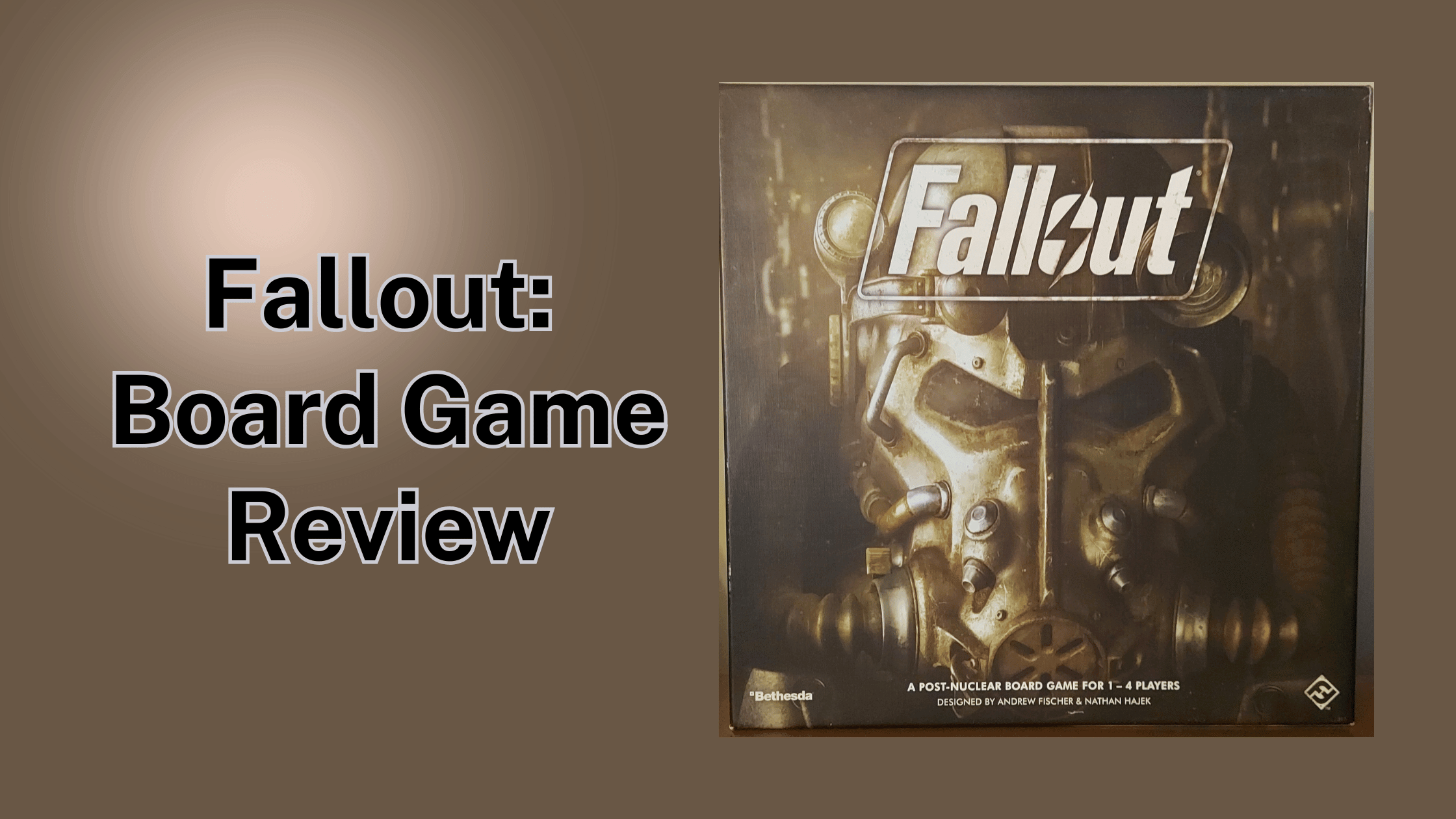
Explore a post-apocalyptic wasteland, complete quests, and navigate warring factions in this narrative board game based on the hit video game series.
Players: 1-4 | Time: 2-3 hours | Age: 14+ | My Rating: 5 out of 5 cupcakes
What Is Fallout: The Board Game?
If you’ve ever played any of the Fallout video games, you already know the feeling this game is going for. The wasteland. The radiation. The factions. The moral gray areas. The vaults full of weird experiments. Fallout: The Board Game, published by Fantasy Flight Games in 2017, nails all of that.
It’s a narrative adventure game for 1 to 4 players that can be played solo or cooperatively, though players can also compete for the most influence. Games typically run 2 to 3 hours.
How It Works
Players start at the edge of an unknown map. The board uses face-down hex tiles that you flip over as you explore, which means you never fully know what’s coming. You’ll encounter enemies, complete quests, collect loot, and level up your survivor’s skills along the way.
The game includes four different scenarios based on Fallout 3 and Fallout 4, each with its own storyline, objectives, and set of quests. Quests drive the narrative and earn you influence points. Who wins depends on who has the most influence when the game ends, which happens when one faction gets pushed to the end of its power track.
Factions Matter
Like the video games, you’ll have to decide which factions to support or oppose. Push one faction to power too quickly and the whole wasteland falls under their control, ending the game early. Balancing that tension is part of what makes the game so interesting. You’re not just playing for yourself. You’re constantly monitoring the state of the world.
The Vaults Are a Highlight
Scattered across the map are vaults, just like in the games. Discovering one opens up a whole new encounter deck with a self-contained story inside. They’re often bizarre, sometimes unsettling, and always memorable. Finding a vault and seeing what’s inside is one of the best moments the game offers.
Who Is This For?
Fallout fans will get the most out of this one, but it’s genuinely enjoyable even without that background. The storytelling is strong enough to carry anyone into the world. Just know it leans more toward narrative adventure than pure strategy.
Do I Recommend It?
Yes. It’s a rich experience with excellent theme integration and plenty of replay value across the different scenarios. Set aside enough time, grab some snacks, and enjoy the wasteland.
And again, just like Firefly, because this is now also a TV show…we’ve been known to play it while we watch the show.
My Rating: 5 out of 5 Cupcakes
A fantastic narrative adventure with incredible theme. Fallout fans will love every minute.
I definitely love playing this one with my husband. Any time we’ve played, we end up leaving it set up for several days because we’ll play it a while, stop, and then come back later to finish it. We take a long time to play games like this because of how into it we get!
In this post, we’re discussing live streaming’s explosive growth in content creation. Is live streaming right for you?
The creation, sharing, and consumption of content are revolutionized by live streaming in the rapidly changing digital ecosystem. Live streaming is a crucial component of contemporary content development, from fascinating game broadcasts to interesting live events and interactive Q&A sessions. Creators, influencers, and companies now have more options to interact in real time with their audiences around the world thanks to the exploding rise of live-streaming platforms. Get ready to explore the expansion of live streaming, its effects on numerous industries, and its potential to reshape the future of communication and entertainment.
Accessibility
The widespread availability of high-speed internet connections and the proliferation of mobile devices have made live streaming accessible to a global audience. People can now easily stream and consume live content from anywhere, anytime, using their smartphones, tablets, or computers, making it a popular form of entertainment.
Interactive and Real-time Engagement
Live streaming provides a unique opportunity for real-time interaction between content creators and their audiences. Viewers can engage with streamers through live chat, comments, gifting, and social media, fostering a sense of community and connection. This interactivity distinguishes live streaming from traditional forms of media and enhances the overall experience for both creators and viewers.
Diverse Content
Live streaming encompasses a wide range of content genres, catering to various interests and preferences. From gaming streams and esports complete with dual monitors and microphones to music performances, talk shows, tutorials, cooking demonstrations, and even everyday life vlogs, there is something for everyone to enjoy. This diversity allows individuals to find and connect with content that resonates with them.
Monetization Opportunities
The rise of live streaming has opened up new avenues for content creators to monetize their work. Platforms often provide features like channel subscriptions, virtual gifts, sponsorships, and ad revenue sharing. Additionally, creators can leverage brand partnerships, merchandise sales, and crowdfunding to generate income. As a result, many individuals have turned live streaming into a full-time profession.
Social Media Integration
Live streaming has seamlessly integrated with popular social media platforms, such as YouTube, Facebook, Instagram, and Twitch. This integration has significantly expanded the reach of live content, allowing creators to tap into their existing follower base and attract new audiences.
Authenticity and Unfiltered Content
Live streaming offers a raw and unfiltered form of content creation. Unlike pre-recorded videos, live streams often capture genuine reactions, spontaneity, and authenticity. This real-time element creates a unique bond between creators and viewers, fostering a sense of trust and relatability.
Rise of Influencer Culture
The rise of influencer culture has also played a crucial role in the growth of live streaming. Influencers, who often have large online followings, leverage live streaming to connect with their fans on a more personal level. This direct interaction enhances their influence and further fuels the growth of live streaming.
Technological Advancements
Technological advancements have significantly improved the quality and accessibility of live streaming. Higher internet speeds, improved video compression algorithms, and better streaming infrastructure have led to smoother and higher-quality live streams. Additionally, the integration of augmented reality (AR), virtual reality (VR), and other interactive elements has enhanced the viewer’s experience.
Collaboration and Co-creation
Live streaming has facilitated collaboration and co-creation among content creators. They can come together to host joint streams, participate in interviews, or collaborate on creative projects. This not only expands their reach but also allows for unique and engaging content that combines the talents and expertise of multiple creators.
Event Coverage and Breaking News
Live streaming has become a go-to platform for event coverage and breaking news. News outlets, journalists, and citizen reporters often use live streams to share real-time updates, on-the-ground reporting, and interviews. This immediacy and unfiltered nature of live streaming provide a fresh perspective and allow viewers to experience events as they unfold.
Community Building
Live streaming has the power to build strong communities around content creators. Viewers often develop a sense of belonging and form connections with like-minded individuals who share their interests. Creators can foster this sense of community by engaging with their audience during streams, hosting dedicated community events, and establishing fan clubs or memberships.
Education and Skill Sharing
Live streaming platforms have become popular spaces for educational content and skill sharing. Creators can offer live tutorials, workshops, or Q&A sessions, providing valuable knowledge and expertise in real time. This has democratized education and allowed individuals to learn from industry experts and professionals regardless of their geographical location.
Charity and Fundraising
Live streaming has also emerged as a powerful tool for charitable causes and fundraising efforts. Content creators often host charity streams where viewers can donate money to support a specific cause or organization. The interactive nature of live streaming allows for immediate engagement and real-time updates on donation goals, creating a sense of collective impact.
Personal Branding and Entrepreneurship
Live streaming offers a platform for individuals to build their brands and explore entrepreneurship. Content creators can showcase their unique skills, personalities, and expertise, establishing themselves as influencers or experts in their respective fields. This personal branding can open doors to collaborations, sponsorships, and other business opportunities.
Cultural Exchange and Global Reach
Live streaming transcends geographical boundaries and enables cultural exchange on a global scale. Creators from different countries and backgrounds can connect with audiences worldwide, sharing their perspectives, traditions, and experiences. This fosters understanding, appreciation, and a sense of global community.
Evolution of the Entertainment Industry
Live streaming has disrupted the traditional entertainment industry by offering alternative forms of entertainment. Platforms like Twitch have propelled esports and gaming into the mainstream, while musicians and performers have found new avenues to reach audiences through live concerts and performances. This shift has challenged traditional media and forced established entities to adapt to changing consumer preferences.
Live streams are taking over
In this new era of content creation, live streaming has cemented its place as a captivating and transformative force. Embracing its potential can empower creators, businesses, and audiences alike to be part of a global conversation that enriches, educates, and entertains in real time. Let us embrace this new era with curiosity, responsibility, and creativity as we shape the future of content creation through the magic of live streaming.
So you want to get a podcast on YouTube? Excellent idea! Read this post to learn how to do it quickly!
Note: This post does contain affiliate links. If you purchase any product/service through one of my affiliate links, this website will receive a small commission at no additional cost to you. Thank you for your support!
Hey, hey, future YouTube podcasters!
Are you ready to add some extra sparkle to your podcasting journey? Oh boy, have I got a treat for you! 🎉 In this kickASH blog post, we’re going to dive into the magical world of turning your podcast episodes into awesome YouTube videos – and we’re going to do it lightning fast!
Yep, you read that right. I know you’re eager to share your fantastic podcast with even more awesome potential listeners, and YouTube is the place to be! So, get ready for a whirlwind adventure as we guide you step-by-step on how to start your very own podcast YouTube channel.
Now, we know you might be thinking, “But, how do I do it quickly and easily?” No worries, my bloggy friend! I’ve got your back! Below I’ll reveal the quickest and easiest method to get your fantastic podcast episodes right onto YouTube as fabulous videos.
Get those creative hats on, buckle up for an exciting ride, and let’s get your podcast soaring high on the YouTube algorithm! 🚀🎙️
Step 1 – Create a YouTube Channel
Here’s the Reader’s Digest version of how to start a YouTube channel:
Sign in or Create a Google Account: If you already have a Google account (like Gmail), great! If not, don’t worry – creating one is a breeze! Just go to Google and click “Sign In” or “Create Account.”
Go to YouTube: Once you’re signed in with your Google account, head over to YouTube (youtube.com) and click on the “Sign In” button if you’re not already signed in.
Create Your Channel: Click on your profile picture (or the cute avatar) in the top right corner of the YouTube page. Then, click on “Create a Channel” and follow the easy-peasy steps to set up your very own YouTube channel!
Choose a Channel Name and Picture: Pick a fun and catchy name for your channel, something that represents you or your content. You can also add a cool profile picture – it could be a photo or a logo that’s totally you!
Customize Your Channel: Make your channel feel like home by adding a cool cover photo and writing a short description about what your channel is all about. It’s like decorating your own creative space!
Upload Your First Video: Get ready to share your fantastic content! Click on the big ol’ “Upload” button (it’s usually an arrow pointing up) and select the video you want to share with the world. While it’s uploading, you can add a title, description, and some fun tags to help people find your video.
Share and Spread the Joy: Ta-da! Your first video is now on your channel! Share it with your friends and family on social media and tell them to check out your awesome new YouTube channel!
Keep Creating and Having Fun: You’re now officially a YouTuber! Keep making more videos, sharing your passions, and having a blast on your channel. Remember, the more you create, the more fun you’ll have, and the more subscribers you might get!
There you go – your simple and quick guide to start a YouTube channel! Now, let’s get those podcast episodes on your channel so you can show the world what you love to talk about, and spread joy with your amazing content. Let’s do this! 🌟🎉
Step 2 – Get a Podcast Hosting Account with RSS.com
If you don’t already have a podcast yet, and want to start one, you can get started for free with RSS.com! And, use code RSSFREEMONTH for a free month of podcast hosting at checkout.
Why am I pushing RSS.com for this step? It offers the easiest way to get your podcast on YouTube fast. How? Let me explain….
When you sign up for RSS.com, you get instant access to their PodViz integration. PodViz is their ahhhhhmazing audio to video tool that lets you create YouTube videos AND load them to your YouTube channel with just one click.
It takes your podcast episode title, episode description, transcript, chapters and more and turns it into a moving picture video.
Here’s what my first PodViz video looks like on my own YouTube channel:
My goal is to turn all of my past and future podcast episodes into YouTube videos so I can score sweet access to a whole mess of potential new listeners. It’s seriously that easy to get your podcast on YouTube! I couldn’t believe it the first time I played with the feature.
By the way – this is why it’s so important to have an awesome description for your episodes, and put some thought into your episode titles and chapter titles too. I’m going through the process of updating my back catalog before I distribute all of my old episodes to YouTube to give them the best possible chance of finding the right people.
Step 3 – Make a Bunch of Podcast Episodes and Turn Them Into Videos
Okay, so admittedly, this is going to be the most time consuming part of getting your podcast on YouTube. BUT, if you have a whole backlog of episodes like I do, you can start distributing those sexy pieces of content as videos immediately.
Once you click the button to generate a video onto your YouTube channel, you will receive an email that says it’s been published and voila! One more opportunity to get access to a plethora of people who could become your next superfans!
And, if you have a podcast on some other platform and want to transfer to RSS.com, you can get SIX MONTHS of free podcast hosting when you switch. Just head here, scroll down on the page and click “Switch to RSS.com now” and you will be guided through every step of the way
You should also watch this video on how to create a podcast playlist on YouTube so you can get access to YouTube’s podcaster perks:
As I start loading more of my podcast episodes, I’ll be sure to update this page with my progress, what I’m experiencing, and all the things.
Thanks for stopping by. If you want to learn more about how to start a podcast, check out one of these posts:
Want to learn how to launch and grow a podcast? If so, this podcasting YouTube roundup is perfect for you!
Note: This post does contain affiliate links. If you purchase any product/service through one of my affiliate links this website will receive a small commission at no additional cost to you. Thank you for your support!
Podcasting YouTube Roundup – 9 Videos to Help You Start Podcasting
I don’t know about you, but a lot of times when I’m trying to learn something, I’d rather watch YouTube than read a blog post. That’s partially where the idea for this post started – watching YouTube. Then, when my bloggy friends over at RSS.com suggested sharing some of their amazing content with my audience it was the nudge I was waiting for to create this Podcasting YouTube Roundup for you to read, er I mean watch 🤣
And, I’m going to toot my own horn a little bit. Here’s a a playlist of all the episodes I’ve produced and hosted so far on behalf of RSS.com:
Finally, here’s a playlist of the “Quick Hits” of the episodes I’ve produced and hosted if you’re short on time, but want the knowledge bombs guests dropped over the past couple of years:
My husband and I went and visited the Smokies. Learn what I thought about my first time in the Great Smoky Mountains!
Driving Through the Smoky Mountains – My First Time
Yee-haw, ya’ll! I just got back from the doggone best trip ever to the Great Smoky Mountains, and I can’t wait to tell y’all all about it! Let me tell you, the Smoky Mountains blew my cowboy boots off. As soon as I caught my first glimpse of those rolling green peaks disappearing into the misty blue horizon, I tell you what, my jaw dropped faster than a calf at branding time. That’s right, the views in this neck of the woods are absolutely stunning.
So buckle up and get ready for the ride of your life, because I’m gonna take you through the highlights of my first trip to the most visited national park in the good ole US of A. From scenic drives prettier than a painted pony, to hiking trails that’ll have you happier than a pig in slop, to exploring mountain towns full of more Southern charm than granny’s sweet tea. Yessir! This is gonna be more fun than a square dance at the county fair!
Now I know I got a little carried away with all those “yeehaws” and “doggos” earlier. And while I do love me some Southern slang – I did move to Kentucky in 2021 after all – I actually do want to tell you properly about how jaw-droppingly beautiful the scenery is in the Smokies.
In all seriousness, driving through the mountains here is like cruising through a real life oil painting. The smokey blue ridges just roll on forever into the horizon. We’re talking views more stunning than your Granny Betty Lou’s wedding photos.
Hi Granny Betty if you’re reading this!
The Newfound Gap Road winds right through the middle of the park with one picture-perfect vista after another. Make sure to stop at the overlooks for iconic views like the one from Clingmans Dome, the highest point in Tennessee. Just be ready for some serious crowds trying to sneak into your pictures!
No seriously! We found ourselves in lines more than once as we tried to snap the perfect Facebook worthy pic!
Further down Newfound Gap, stop at the Chimney Tops overlook for one of the best panoramas of the ancient mountain peaks shrouded in silvery mist. No fancy camera skills needed, the views look like professional postcards no matter which way you point your lens.
And be sure not to miss the Roaring Fork Motor Nature Trail loop, where you’ll feel like you passed through a time portal to the old days of log cabins, churches, and tub mills. The mountain farmsteads are sure to spark some wholesome nostalgia.
So if you’re looking for that perfect profile pic, just take one of the scenic drives. The Great Smoky Mountains will give you all the camera candy you can handle!
Hiking Trails for Next Time
Now on this first trip, my husband and I only had one day to explore the Smokies. So sadly, we didn’t actually get to hit any of the amazing hiking trails. I know, I know, that’s like going to Disney World and only riding the merry-go-round once.
But from the car, we could glimpse some of the incredible trails weaving through the lush forests and up into the misty mountains. And let me tell you, it took everything in me not to jump out and start trekking those wooded paths!
We drove by trailheads that lead to iconic routes like the Appalachian Trail and saw hikers on their way up to stunning destinations like Laurel Falls. Watching those tiny people marching up the steep slopes, I felt my hiking shoes get a bit jealous.
I was especially bummed we couldn’t make the tough climb up to the Chimney Tops. That panoramic view from the unique dual-peaked summit looked absolutely magical in the brochures I found at the rest stop on our way into Tennessee! But a mile-high hike is not something we could squeeze into a quick day trip.
However, this just gives us all the more reason to come back and spend a whole week immersed in the mountains. I cannot wait to finally hit trails like Hen Wallow Falls and experience the roar of water crashing down a 90-foot cascade.
I reckon we’ll have to get some doggy backpacks for Baileys and Kahlua because I don’t see my doggos trekking up the rocks – ya know what I mean?
And we definitely have to come back and spot some of the iconic Smoky Mountain wildlife, like black bears, turkeys, and whitetail deer. Safely viewing these creatures in their natural habitat would be the experience of a lifetime!
So while we made the most of the scenic drives on this first trip, we are already counting down the days until we can return to the wonderland of trails in the Great Smoky Mountains! I just know those views overlooking all that was below were just a teaser for the beauty awaiting us on foot.
Exploring the Nearby Town
After soaking up the natural splendor in the mountains, head down to the local towns for some fun. The mountain resort city of Gatlinburg offers family entertainment, kitschy shops, and Southern cuisine. But one of my favorite stops was the Gatlinburg Winery shop.
This winery has been crafting specialty wines with unique local flavor right at the entrance to the Great Smoky Mountains since 2017. We visited their tasting room to try their famous cotton candy wine – and let me tell you, it was deliciously sweet bliss in a glass!
The winemaker Nolan has nearly two decades of experience perfecting his craft. His goal is for every sip to capture the essence of Gatlinburg’s beauty and Southern hospitality.
Thousands flock to the winery to try the signature cotton candy wine that started it all. The blush-colored, carnival-inspired sipper tastes exactly like the sugary pink cloud we all know and love. It’s no wonder this wine spawned a nation-wide cotton candy wine obsession!
But cotton candy is just one of many fruity, flavorful wines offered. You can get a free tasting flight to sample award-winning wines like their Blueberry Muffin. Or join the Gatlinburg Winery Club to get new specialty releases shipped to your door.
With the misty blue Smoky Mountains as the backdrop, the tasting room provides the perfect atmosphere to sip these one-of-a-kind wines. The exceptional pours and welcoming hospitality encapsulate the charm that makes Gatlinburg a true gem.
So next time you’re exploring the mountain towns, make the Gatlinburg Winery a sweet stop. Their wines offer a delicious taste of this special region!
I Can’t Wait to Go Back!
The Great Smoky Mountains exceeded all my expectations for natural splendor on my first visit. While we only had time to experience the park by car, the scenic drives gave us a taste of the breathtaking vistas, misty peaks, and wooded wilderness that make this the most visited national park.
Driving through paradise-like panoramas on Newfound Gap Road and the Roaring Fork Motor Trail was just a teaser. I cannot wait to return and dive deeper into those mountains on the amazing hiking trails. Walking beside thundering falls and climbing to the summits of the iconic peaks is now at the top of my travel bucket list.
And the local mountain towns like Gatlinburg and Cades Cove offer such a fun way to soak up the culture, history and cuisine of the Smokies region. From moonshine distilleries to wineries serving up specialty sips, there is so much still left to explore.
While this trip may have been a quick introduction, the stunning scenery and warm hospitality have me hooked. I’m already counting down the days until I can return to the wonderland that is the Great Smoky Mountains!
Want to know how to start a health and wellness podcast? You’ve come to the right place!
Everything You Need to Know About How to Start a Health and Wellness Podcast
🎙️🌿 Ready to dive into the world of health and wellness with a microphone in hand? 🎧🏋️♀️ Say hello to your future as a podcasting powerhouse, where you’ll blend captivating conversations, expert insights, and a sprinkle of fun to create the ultimate audio elixir for your audience! Whether you’re a wellness guru, a fitness fanatic, or just someone with a passion for spreading good vibes and better habits, it’s time to turn up the volume on your dreams and learn how to kickstart your very own health and wellness podcast! 🎉✨
Welcome to a realm where “gains” aren’t just about muscles, “detox” doesn’t mean a digital cleanse, and “OM” isn’t just a three-letter word. Get ready to curate content that nourishes minds, strengthens bodies, and fills hearts with inspiration. From heart-pumping workout routines to deliciously nutritious recipes, from mindfulness mantras to the latest wellness trends, your podcast is about to be the one-stop-shop for all things healthy, happy, and whole.
So channel your inner Zen master, and prepare to spread good vibes like a smoothie maker on overdrive. We’ll guide you through the essential steps, sprinkle in some tech-savvy tricks, and share a dash of dad-jokes along the way. Hopefully, by the time we’re through, you’ll be a podcasting pro, radiating positivity and transforming lives one episode at a time!
Buckle up, buttercup! Your journey to becoming the go-to guru of health and wellness podcasts is about to take off! 🚀🌈
Finding Your Niche: Unleash Your Inner Wellness Warrior! 🗡️
Discovering the Superpowered Topics That Fuel Your Passionate Podcast Persona.
When starting a health and wellness podcast, it’s essential to find your niche – that magical sweet spot where your expertise meets your passion. Reflect on what excites you the most in the world of wellness. Are you a fitness guru, a nutrition enthusiast, a mental health advocate, or a meditation maestro? Embrace your unique strengths and interests, and let them guide your podcasting journey.
Consider your target audience and the problems they face. What knowledge and insights can you offer to make their lives better? Whether it’s sharing workout routines, exploring the latest health trends, or discussing mindfulness practices, find the topics that ignite your wellness warrior spirit and align with your listeners’ needs. Remember, you’re not just a podcast host; you’re a superhero spreading wellness wisdom!
Defining Your Target Audience: Ready, Set, Woo Your Wellness Tribe! 🎯
Identifying Your Dreamy Listeners and Creating a Podcast Connection Like No Other.
Your health and wellness podcast’s success depends on knowing your audience like the back of your yoga mat. So grab your crystal ball and delve deep into the minds and hearts of your dream listeners. Who are they? What motivates them? What challenges do they face? Understanding your audience is the secret ingredient to crafting content that resonates with their souls.
Take a trip down social media avenues, join wellness forums, and engage with potential listeners to gather valuable insights. Once you have your target audience in sight, create a listener avatar – a vivid representation of your ideal listener. Personalize your content, speak directly to them, and make them feel like an integral part of your wellness tribe. Trust me; they’ll be your most loyal supporters on this podcasting adventure!
Master the Art of Entertaining Episodes and Keep Your Audience Begging for More!
Creating captivating content is the heartbeat of your health and wellness podcast. Imagine each episode as a blockbuster movie, with you as the star director! Structure your show with a catchy intro, juicy main content, and a memorable outro that leaves your listeners craving more.
Be a wellness wordsmith! Weave stories, share personal anecdotes, and sprinkle in humor to keep your audience entertained and engaged. Don’t shy away from bringing on guests – experts, fellow wellness enthusiasts, or even everyday people with inspiring stories – to add variety and fresh perspectives.
Stay true to your podcast’s theme while exploring different angles and approaches to keep things exciting. Embrace your creativity, and don’t be afraid to experiment with different formats. Remember, when it comes to crafting content, the more delightful surprises you include, the more your listeners will be hooked on your show!
Choosing the Right Format: Solo Superstar or Group Dynamo? 🌟💬
Exploring Podcast Formats to Find Your Signature Style!
As you embark on your podcasting journey, it’s time to decide which format suits your wellness wizardry best. Will you be a solo superstar, captivating listeners with your personal insights and wisdom? Or would you prefer a group dynamo format, engaging in lively discussions with fellow wellness enthusiasts or industry experts?
Solo episodes allow you to express your unique voice and expertise, while group formats offer dynamic conversations and diverse perspectives. You could also blend both worlds, featuring solo episodes for in-depth topics and group episodes for lively debates and interviews.
The format you choose will shape your podcast’s personality, so take your time to experiment and find what feels most authentic and fun for you. Remember, whether you’re flying solo or assembling a podcasting dream team, your wellness wisdom is destined to shine through!
Preparation and Research: Health Detective Mode: Uncover the Juiciest Wellness Secrets! 🔍🕵️♀️
How to Prepare for Your Episodes Like a Pro.
Just like a wellness detective, gather all the evidence and insights you need to create informative and impactful episodes. Prior to recording, invest time in thorough research to ensure your content is credible, accurate, and up-to-date.
Delve into reliable sources, scientific studies, and expert interviews to bolster your knowledge. Take notes, organize your findings, and create an outline to guide your episode’s flow.
But wait, there’s more! Prepare your vocal cords and get into podcasting Zen mode. Sip some herbal tea, do vocal warm-ups, and ensure you have everything ready to record like a seasoned pro. With your detective skills and preparation game strong, you’re all set to be a wellness Sherlock, revealing the juiciest wellness secrets to your eager listeners!
Equipment and Recording Setup: Sonic Wizardry: Unleash the Power of Podcasting Potions! 🧙♂️🎙️
Essential Gear and Recording Tips for Crystal Clear Audio.
To conjure magical podcast episodes, you’ll need the right equipment and recording setup. Fear not, for you don’t need wizard-level knowledge to master this art!
Start with a good quality microphone – your trusty magic wand for clear and professional-sounding audio. Pair it with headphones to monitor your voice and catch any gremlins that might sneak into your recordings.
For a recording environment that rivals the tranquility of a mystical forest, consider acoustic treatment. Tame echo monsters and pesky background noises with soundproofing materials or by recording in a cozy corner surrounded by pillows and blankets.
Feeling tech-savvy? Embrace the power of recording software! Choose from a range of enchanting options that allow you to edit and mix your episodes like a true audio alchemist.
Remember, you don’t need an elaborate potion laboratory to get started – just the right gear and a sprinkle of podcasting passion!
Editing Magic: Abra-Cadabra-Edit! 🎩✨
Turning Raw Recordings into Podcast Gold – The Art of Editing Like a Podcast Pro!
Once you’ve captured your audio treasures, it’s time to work your editing magic and transform them into polished podcast episodes. Embrace your inner wizard and trim the excess, snip any awkward pauses, and ensure your audio flows seamlessly.
Add a dash of music to set the mood and add sparkle to your show. But beware of overdoing it – a light touch of enchanting tunes will suffice!
Don’t forget to wield your mastering skills to ensure balanced audio levels, making your episodes a pleasure to listen to for all magical beings.
Remember, editing is where the real podcasting sorcery happens, so practice your skills and let your episodes shine like shimmering gems in the podcasting realm!
Creating Eye-Catching Artwork and Branding: From Blah to Awe – Podcast Artwork that Pops! 🎨🌈
Designing Your Show’s Dazzling Look and Feel.
In the visual realm of podcasting, your artwork is your beacon, drawing listeners to your show like moths to a mesmerizing flame. So, let your creative prowess take center stage!
Craft an eye-catching podcast cover that reflects your show’s essence and instantly grabs attention. Embrace vibrant colors, playful graphics, and, of course, your sparkling podcast title. A touch of mystique never hurt either!
Consistency is key in the podcasting cosmos, so ensure your artwork aligns with your branding across social media and your website. Let your visual identity be a magical thread that weaves through every aspect of your wellness podcasting adventure!
Choosing the Perfect Title and Description: Wordsmithing Wonders: Title Tricks that Cast a Podcasting Spell! 🪄📜
Crafting Descriptions That Lure Listeners In with Magic and Charm.
Your podcast’s title and description are like incantations that summon curious listeners from far and wide. Choose them wisely, for they hold the power to captivate and enchant!
Your title should be a tantalizing tease that reveals your show’s essence and sparks intrigue. It should be memorable, easy to pronounce, and convey the heart of your wellness journey.
Pair your title with an enchanting description that provides a taste of what’s to come. Be playful, authentic, and let your personality shine through!
Remember, the right words can work wonders, so sprinkle your podcasting magic to craft a title and description that beckon listeners to enter your captivating world of wellness wonder!
Setting Up Your Podcast Hosting and Distribution: The Podcast Portal Unveiled! 🌐🚀
Your Journey from Recording to Global Airwaves.
Once you’ve brewed your podcasting potion, it’s time to unveil your show to the world! The magical portal to the podcasting universe lies in podcast hosting and distribution platforms.
Choose a reliable hosting platform where you can upload your episodes and unleash them into the digital cosmos. From there, your episodes will be distributed to various podcast directories like Apple Podcasts, Spotify, Google Podcasts, and more, reaching listeners across the globe.
But beware, brave podcaster, for the first step is just the beginning of your quest! Stay consistent with your episodes, keep your wellness magic flowing, and engage with your listeners on this fantastical journey. With each new episode, you’ll be summoning a community of wellness enthusiasts, all connected through the power of your podcasting spell!
Promoting Your Podcast: Be a Social Media Sorcerer! 🧙♂️📱
Unleash Your Podcast’s Potent Promotional Powers to Conquer the World!
As a podcasting sorcerer, you wield a mighty wand – the power of social media! Embrace the digital realm to cast your promotional spells far and wide.
Harness the magic of eye-catching graphics, captivating captions, and engaging content to entice potential listeners. Share sneak peeks, behind-the-scenes insights, and teasers to build excitement for upcoming episodes.
Join forces with other wellness wizards, collaborate on guest episodes, and cross-promote each other’s shows. Together, you’ll create a podcasting alliance that inspires listeners and expands your collective reach.
Don’t forget to use your charming personality to interact with your audience. Respond to comments, acknowledge feedback, and create a community where your listeners feel valued and supported.
With the right mix of social sorcery, your health and wellness podcast will enchant listeners from all corners of the digital realm!
Monetization and Sponsorships: Show Me the Wellness Moolah! 💰💸
Unlocking the Treasure Trove of Podcast Monetization.
As your podcasting journey evolves, you may wonder how to turn your wellness passion into a rewarding venture. Fear not! There are mystical paths to podcast monetization.
Consider seeking sponsorships from wellness brands that align with your values and resonate with your audience. You can also explore affiliate marketing, where you recommend products or services and earn a share of the profits.
For an even more enchanting approach, offer exclusive content or bonuses to your loyal listeners through a membership or donation platform. Your dedicated supporters will gladly contribute to your podcasting magic!
But remember, noble podcaster, that passion and authenticity are the heart of your wellness podcast. Let your monetization ventures flow naturally from your genuine desire to create valuable content that uplifts and empowers your listeners.
Connecting with Your Audience: Heartfelt Hugs and Virtual High-Fives! 🤗🙌
How to Forge Deep Bonds with Your Loyal Listeners.
In the realm of health and wellness podcasting, connection is the key to unlocking hearts and transforming lives. Embrace your inner hugger and connect with your audience on a profound level.
Respond to listener feedback, messages, and reviews with gratitude and warmth. Personalize your episodes by sharing stories of your own wellness journey, making your listeners feel like cherished friends.
Host Q&A sessions, surveys, and listener-driven episodes to let your audience be an active part of your podcasting adventure. This two-way magical bond will create a loyal tribe of supporters who will follow your wellness wisdom faithfully.
Be the guiding light, the supportive cheerleader, and the friend that your listeners can count on as they embark on their own wellness quests. With your heartfelt connections, your health and wellness podcast will become a beacon of hope and inspiration for all who tune in!
Networking and Guest Invitations: Call in the Wellness Avengers! 📞🦸
How to Assemble a Cast of Expert Superheroes for Your Podcast.
The podcasting universe is brimming with wellness experts, enthusiasts, and everyday heroes. Harness the power of collaboration and summon a diverse cast of guests to enrich your show with wisdom and magic!
Reach out to health and wellness experts whose knowledge aligns with your podcast’s theme. Invite them to share their insights, tips, and personal journeys with your listeners. The diverse perspectives of your guests will add depth and richness to your episodes.
But don’t stop there! Give everyday wellness warriors a chance to shine too. Your listeners will be inspired by relatable stories of transformation and resilience.
Forge connections with your guests, shower them with gratitude, and build lasting relationships. The bonds you create will ripple beyond your podcast, opening new doors to future collaborations and shared adventures in the world of wellness!
Analytics and Measuring Success: Number-Crunching Ninja! 📈🥷
Decoding Podcast Metrics and Leveling Up Your Impact.
As a wise health and wellness podcast host, you need not fear the realm of podcast analytics. Armed with insights, you’ll track the impact of your episodes and journey toward podcasting greatness!
Explore your podcast hosting platform’s analytics to unveil a treasure trove of information. Learn about your audience’s demographics, listening habits, and which episodes cast the most potent spells.
Use this knowledge to fine-tune your content, optimize your promotion strategies, and continue captivating your listeners with enchanting episodes.
But remember, young ninja, podcasting success is not merely measured in numbers. The true power of your wellness podcast lies in the positive change it brings to your listeners’ lives. As long as your magic touches hearts and empowers minds, you are the stealthy success story of the podcasting dojo!
Staying Consistent and Committed: Podcasting Zen Master! 🧘♂️⌛
How to Maintain Your Podcasting Serenity and Keep the Momentum Flowing.
In the podcasting realm, consistency is the key to sustaining your wellness magic. Channel your inner podcasting Zen master and cultivate the art of commitment.
Create a podcasting schedule that aligns with your life and allows for a steady flow of episodes. Your listeners will appreciate the reliability of your magical transmissions.
Stay organized, plan ahead, and keep a backlog of episode ideas. This way, you’ll maintain your momentum even in the face of the occasional spellcasting hiccup.
Remember, dear Zen master, podcasting is a journey of continuous growth. Embrace the learning process, adapt to challenges, and celebrate your progress. With your unwavering dedication, your health and wellness podcast will flourish and become a timeless source of wisdom in the podcasting cosmos!
Congratulations, mighty podcaster! You now possess the mystical knowledge to start and nurture a captivating health and wellness podcast. Embrace your unique voice, share your wellness wisdom, and spread your positive vibes far and wide.
May your podcasting adventure be filled with enchantment, empowerment, and endless inspiration for all who tune in! 🎙️✨
Want to make money online? In this post, we’ll explore 9 steps to affiliate marketing profits to get you paid faster!
Dive into the World of Affiliate Marketing: A Comprehensive Guide to Boost Your Online Income
Hey there, future affiliate marketing superstar! 🌟 Ready to dive into the exciting world of online entrepreneurship? Buckle up, ’cause we’re about to reveal the secret sauce to affiliate marketing profits!
Sure, it might seem a bit overwhelming at first, but fear not! The hustle you put into becoming an affiliate is totally worth it. Picture this: as you consistently serve up top-notch content, your income can grow like a snowball, getting bigger and better with time!
Now, let’s get down to business with the fantastic nine steps to launch your affiliate marketing adventure. These epic moves will put you on the fast track to conquer various niches and platforms, scoring awesome revenue and commissions along the way.
You’re in the driver’s seat, buddy! Whether you’re in for a thrilling joyride or a chill journey, we’ve got the perfect products waiting for your magical recommendations. And guess what? These eager vendors can’t wait to shower you with fabulous rewards for your hard work.
So, gear up, keep that passion flowing, and rock the affiliate world like the superstar you are! 🚀💰
Step 1: Selecting Your Niche – Embrace Your Passion and Expertise
Are you ready to kickstart your epic journey into the realm of affiliate marketing? Step one, here we go! 🚀
Picture this: you’re standing at the crossroads of infinite possibilities, and the key to success is choosing the perfect niche. So, pick a topic that genuinely makes your heart skip a beat! If you’re not into health stuff, skip the medical advice blog, my friend. Embrace what lights up your soul, and your readers will feel the vibes too!
Passion and expertise are your secret weapons! 🔥 When you’re all fired up about your niche, your content will be like a magnet, pulling in curious readers who can’t wait to check out the awesome products you recommend.
Ready to dive into uncharted territories? No worries! Arm yourself with knowledge through research. Your readers will bow to your wisdom, trusting you with their affiliate journey!
Step 2: Understanding Your Audience’s Desires
Imagine your audience as a treasure trove of precious gems, each seeking something unique to fulfill their needs and aspirations. Your mission? Craft content and promote products that speak right to their hearts! 💖
Ready to unleash the magic of keyword research? 🔍 Get those creative gears turning by exploring platforms like WordStream, Google Keyword Planner, and Wordtracker. They’re like your trusty compass, guiding you towards what your audience is really searching for.
Say you’re into gifts (who isn’t, right?). Digging deeper, you’ll uncover gems like “best Christmas gifts for mothers” – now, that’s a jackpot! 💎
But wait, there’s more! Long-tail keywords are like hidden treasure maps, leading you to untold riches. Questions like “How do I bake a cake from scratch?” are gold mines of inspiration! Turn them into engaging blog posts like “How to Bake a Chocolate Cake From Scratch” – BOOM! 💥
And don’t forget about the friendly forums like Quora! 🗣️ Your audience spills their hearts out there, asking real questions and seeking real solutions. Jump into the conversation, discover their deepest desires, and turn them into epic blog posts that’ll leave ’em wanting more!
Step 3: Establish Your Affiliate Blog – A Foundation for Success
Alright, time to rock and roll with Step 3 in our steps to affiliate marketing profits: Building Your Epic Affiliate Blog! 🎉
Picture this: your blog is like a magical gateway to affiliate success! 🏰 It’s the secret key that opens doors to incredible affiliate programs, making you look like the ultimate affiliate guru!
So, grab your wizard’s hat (or just your laptop) and let’s get this party started! 🧙♂️ Use QuickInstall like a pro to set up WordPress – it’s like your trusty sidekick, reliable and totally free! 🦸♀️
Once your blog is up and running, it’s time to sprinkle some stardust by publishing amazing content. Remember, even if you can’t include those sweet affiliate links just yet, fear not! They’ll come later, and your audience will be ready to gobble up those goodies like candy! 🍭
Having your very own website gives you superhero-level control over your affiliate journey. 💪 Unlike relying solely on social media platforms (we love you, TikTok!), having a blog shields your hard work from any unexpected setbacks. Ain’t no shutdowns gonna mess with your affiliate party!
Get ready to dazzle the affiliate world with your epic blog, and dance your way to affiliate stardom! 🌟🎶
Step 4: Explore Diverse Affiliate Platforms
Your choice of platform is like picking the perfect weapon for your affiliate battles! 🔪 Are you into tangible products, like the coolest gadgets and snazzy stuff? Then get ready to conquer platforms like Amazon, Share-a-Sale, and Commission Junction! They’re the ultimate allies, offering free sign-ups and winning the hearts of affiliate warriors everywhere! 🛍️
But wait, there’s more! If you’re more of a digital wizard, waving your wand to promote eBooks, courses, and other digital delights, you’ve got awesome platforms to explore! 📚 ClickBank, Warrior Plus, and JVZoo are your trusty companions, offering free entry into the digital realm and the highest respect from fellow affiliates! 🌟
Step 5: Embrace the Power of Social Media Marketing
Time to get into harnessing the incredible power of social media marketing – the ultimate secret weapon to conquer the online kingdom! 🛡️
Get ready to unleash your inner influencer on platforms like Facebook, TikTok, Instagram, Pinterest, and YouTube! 🎉 Signing up is a piece of cake, and it’s totally free, my friend! 🍰 Oh, and here’s a pro-tip: keep it simple and use the same username as your blog – that way, folks will remember and connect with your fabulous content in a snap! 🤳
Stay ahead of the game by riding the wave of the latest social media trends! 🌊 From “cleantok” to “trendytik,” be where the action is! So, grab that mop and vacuum, and show ’em how it’s done! 🧹🎥 Share your cleaning wisdom with cool videos, sprinkle those hashtags like confetti, and lead your viewers straight to the treasure trove of amazing products on your blog! 💎💻
And let’s face it – attention spans are shorter than a sneeze these days! 🤧 So, make your content snappy and irresistible! Use bold colors to grab eyeballs, kickstart your videos with mind-blowing questions, and get right to the heart of the matter! Your viewers will be glued to their screens like it’s the season finale of their favorite show! 📺🍿
On Instagram, Pinterest, and Facebook, create picture-perfect posts that’ll have your followers drooling with envy! 📸💖 And for YouTube, keep it snappy – think 10 minutes or less of pure awesomeness! And for TikTok, well, 60 seconds is all you need to win hearts and conquer the viral universe! ⏰💥
Step 6: Select Your Promotional Products Wisely
Are you all about tangible goodies that your customers can hold in their hands? 🎁 Think physical products that land right at their doorstep, making them jump with joy! 🚀
Or are you more of a digital wizard, conjuring up eBooks, courses, and other mind-blowing informational gems? 📚✨ These digital wonders will set your audience’s hearts on fire! 🔥
But hey, here’s the secret sauce: the products you promote depend on your chosen niche! 🎯 For example, if you’re running a toy blog, it’s all about the tangible stuff – kids love those awesome physical toys! 🧸 On the other hand, a spirituality niche is all about the digital delights, like enlightening eBooks and soul-nourishing courses! 🌌
But wait, there’s more! Some niches can mix and match the best of both worlds! 🌈 Take a stress management blog, for instance. It’s got the perfect combo: an eBook on chilling out and zen-worthy items like weighted blankets and essential oil diffusers! 💆♀️🧘♂️
Choose wisely, my friend! Tailor your product promotions to fit like a glove with your niche and your audience’s wildest dreams! 🎯💖
Pro Tip: Only use products and services you have used, like, and trust!
When it comes to choosing the products and services you want to promote as an affiliate, there’s a golden rule you should always follow: “Use, Like, and Trust” – and trust me, if you’re hoping for affiliate marketing success this is a must! 🌟🍔
Imagine for a moment that you stumble upon an affiliate program for a random product that you’ve never used, and you have no idea if it’s any good. But hey, it offers a juicy commission, so you think, “Why not?” 🤷♂️
Well, hold your horses! Remember, you’re not just selling a product; you’re building trust with your audience, your loyal tribe who hangs on to your every word! They look up to you, rely on your recommendations, and expect honesty and authenticity! 🌟💬
That’s where the magic of “Use, Like, and Trust” comes into play! If you promote something you genuinely use, love, and trust, your enthusiasm will be contagious! Your audience will sense the authenticity in your words, and they’ll be like, “Hey, if they vouch for it, it must be amazing!” 🌟💖
On the other hand, if you promote just anything for a quick buck, you risk losing that precious trust you’ve worked so hard to build! And trust me, trust takes time to earn, but it can vanish in a puff of smoke if you’re not careful! 🔥💨
So, choose wisely, dear affiliate warrior! Only promote products and services that align with your values, resonate with your audience, and genuinely add value to their lives! Be like a discerning food critic at a fancy restaurant – pick only the most delectable dishes to recommend! 🍽️👩🍳
And remember, it’s not just about short-term gains! Building long-lasting relationships with your audience is like planting seeds in a magical garden. Nurture them with love and honesty, and watch them grow into a forest of loyal supporters who’ll stick by your side! 🌳🤝
So, let’s make a pact, my affiliate friend: From now on, let’s promise to be the champion of “Use, Like, and Trust”! Share only the best, most fantastic products and services you know will rock your audience’s world!
Step 7: Deliver Value with Exceptional Content
Get ready to drop some knowledge bombs on your readers, ’cause valuable content is the name of the game! 💣🧠 Answer their burning questions with all the juicy deets about those awesome products you’re promoting! 🔥💻 Let your words flow like a river, so clear and captivating that your readers can’t look away! 🌊✨
Oh, and here’s the secret sauce: show ’em why those products are absolute game-changers in their lives! 💪🌟 Convince ’em that these goodies are like magic potions, making their dreams come true and turning their frowns upside down! 😄💫
But hold on tight, ’cause short and sweet just won’t cut it! 🍬🚫 Google loves to see some meaty content on your blog – the more, the merrier! 🏰📈 So, let those words flow freely, my friend, and watch your SEO soar like a majestic eagle! 🦅🔝
And guess what? Brands will be lining up to collaborate with you! 🤝💖 They adore websites with top-notch content, and who can blame them? You’re like a content wizard, making their dreams come true! 🧙♀️✨
Consistency is key in this adventure, my friend! Keep those posts coming like fireworks on the Fourth of July! 🎆💥 Aim to dazzle your readers with fresh, exciting content a few times a week! They’ll be hooked, and your blog will be their favorite hangout spot! 🏰🎡
Step 8: Harness the Power of Your Affiliate Links
Alright, affiliate wizard! 🧙♂️ Step 8 is where the magic happens – it’s time to unleash the power of your affiliate links and turn those clicks into cold, hard cash! 💰💻
So, you’ve got your awesome blog, and you’ve sprinkled it with high-value content – kudos to you, content maestro! 🏆 Now, let’s dive into the world of affiliate programs! Many of them, like Amazon and Warrior Plus, offer free sign-ups! 🎉
Once you’re approved as a full-fledged affiliate ninja, it’s time to sprinkle some fairy dust on your blog posts! ✨ Craft ’em like a pro, making sure to add those magical affiliate links to the products you wanna promote!🪄 Oh, and don’t forget the charm of an eye-catching image to go with it! 📸🌟
Now, here’s the secret sauce: when your readers click on those links and make a purchase, cha-ching! 💸💫 You’ll be earning some serious commission like a boss! 🤑💪
But wait, we’re not stopping there! Social media is our playground, too! 🎢📱 Platforms like TikTok and Instagram have their very own magic trick: Linktree! It’s like a magician’s hat, holding all your affiliate links in one place! 🎩💖 Your followers can easily access all those fabulous links, and you’ll be raking in the rewards! 💵💵
And guess what? YouTube is part of the fun too! 🎥💥 Don’t forget to sprinkle your affiliate links in those descriptions – it’s like planting little money seeds that grow into a beautiful garden of earnings! 🌱🌈
Step 9: Drive Traffic to Your Website
Home stretch on these 9 steps to affiliate marketing profits! Let’s finish strong with some ideas to drive traffic to your website – it’s all about turbocharging your website with an avalanche of visitors! 🚗💨
Now, we’ve got epic content on your blog, and it’s like a treasure trove waiting to be discovered! 💎 But hold up, we gotta get the word out to the right peeps! So, time to put on your traffic-detective hat! 🕵️♂️
First up, let’s sprinkle some SEO magic on your content! 🌟 Find those nifty keywords that your audience is searching for and weave ’em into your content like a pro! It’s like having a secret map that leads treasure hunters right to your blog! 🗺️💖
But wait, we’re not stopping there! It’s time to show your website some love with a splash of advertising awesomeness! 🎯💥 Platforms like Facebook, TikTok, and Google have got the goods – buy those ads like a boss, and watch your website light up like fireworks on the Fourth of July! 🎆🎇
Oh, and here’s a secret weapon: solo ads! 💌🚀 Team up with marketers with big email lists and loyal followers, and boom! Your website’s gonna be like a superstar on the red carpet, getting all the attention it deserves! 🌟📸
Last but not least, be the Sherlock Holmes of your website! 🕵️♀️ Check out those analytics like a pro, ’cause they hold the keys to your traffic kingdom! 🗝️🏰 Keep an eye on what content is killing it, and create more of that magic potion to attract even more visitors! 🧪🔮
So, traffic mastermind, it’s time to hit the gas pedal and drive that traffic like a pro! 🚀💨 Your website is gonna be the hottest spot in town, so let’s make it a party for your visitors to remember! 🎉😎
More Traffic Tips for Affiliate Marketing Success
Here are some additional tips to send your traffic soaring like a rocket! 🌟
1. Social Media Shenanigans: Be the life of the online party! 🎉 Post engaging and shareable content on social media like there’s no tomorrow. Create fun challenges, quirky polls, and entertaining stories to get people talking and clicking their way to your site! 📱💬
2. Play with Partnerships: Join forces with other awesome content creators in your niche! 🤝 Collaborate on exciting projects, guest post on each other’s blogs, and shout each other out! It’s like a dynamic duo taking on the internet together! 🦸♀️🦸♂️
3. Giveaways Galore: Who doesn’t love freebies, right? 🎁 Host jaw-dropping giveaways that’ll have people lining up like it’s a Black Friday sale! Offer irresistible prizes and watch the flood of eager visitors storm your website! 🌊💥
4. Be a Comment Crusader: Engage with your audience like a superstar chat host! 💬🎤 Respond to comments, answer questions, and show that you’re genuinely interested in what they have to say. You’ll build a loyal fanbase that keeps coming back for more of your awesomeness! 🤗❤️
5. Wild and Wacky Content: Stand out from the crowd with out-of-this-world content! 🚀😜 Try quirky quizzes, entertaining animations, or create your own memes. People love to share the bizarre and hilarious, so go ahead and unleash your creative genius! 🎭🤪
6. SEO Sorcery: Summon the power of SEO like a wizard! 🔮 Sprinkle those keywords like magic dust, optimize your meta tags, and create killer headlines that demand clicks! Your website will rise to the top of search engine results like a phoenix from the ashes! 🕊️🔥
7. Email Magic: Don’t forget the enchantment of email marketing! ✉️ Send captivating newsletters and exclusive offers to your subscribers. It’s like having a VIP party where your guests can’t wait to RSVP! 💌🥳
A Quick Recap of the 9 Steps to Affiliate Marketing Profits
Alright, affiliate trailblazer, it’s time for a quick recap of the nine magic steps to rock your way to affiliate marketing success! 🌟✨
Step 1: Choose Your Epic Niche – Grab a topic you’re passionate about and unleash your knowledge like a pro! Let that passion shine through in your content and wow your audience! 💥🎉
Step 2: Understand Your Super Fans – Tune into the minds of your audience like a psychic guru! Analyze their wants and desires, and then sprinkle that magic into your content and product recommendations! 🔮🌈
Step 3: Build Your Affiliate Castle – Create a website or blog that’ll blow everyone’s minds! Showcase your expertise and credibility, ’cause you’re the king or queen of the affiliate world! 👑🏰
Step 4: Dabble in Affiliate Adventures – Go on a thrilling quest to discover the best affiliate programs for your niche! Choose reputable platforms like a savvy explorer seeking hidden treasure! 💎💰
Step 5: Rule the Social Media Realm – Unleash the power of social media like a wizard! Work your magic with engaging content, spark trends, and watch your reach skyrocket like a shooting star! 🌟🧙♀️
Step 6: Choose Products like a Boss – Be the captain of your affiliate ship! Carefully select products that match your niche and audience’s desires, and sail towards epic conversion rates! ⛵🚀
Step 7: Create Content Marvels – Craft extraordinary content that leaves your audience in awe! Deliver value, answer their questions, and watch organic traffic storm your website! 🚀📝
Step 8: Weave the Affiliate Spell – Sprinkle those affiliate links like fairy dust! Integrate them into your content and social media to work some serious commission magic! 💸✨
Step 9: Traffic Wizardry – Master the art of traffic sorcery! Cast SEO spells, conjure strategic ads, and unravel website analytics secrets to summon the ultimate flow of visitors! 🚀🔮
So, my fellow affiliate adventurer, keep hustling, keep enchanting, and never stop growing! Embrace your online kingdom with determination and passion, and soon, you’ll be swimming in the bountiful rewards of affiliate marketing! 🎊💰 Let’s conquer this magical realm together! 🌌🤝
Can you start an online business for five bucks? That’s what this post aims to answer. Read it and find out!
Frugal Marketer’s Guide to Starting an Online Business for 5 Bucks
If you spoke to most people interested in becoming online entrepreneurs, you’d see that many of them feel like their dream is far off in the future. The reason? A lack of money to invest in their business.
There’s a big myth that you have to have deep pockets – that you have to “spend money to make money” online, but nothing could be further from the truth. When listening to the advice of many who teach online marketing, you have to look at their intentions.
While some treasured few genuinely want to help others achieve their goals, some are just in it to line their own pockets – even if that means coaxing you into buying endless courses and tools you really don’t need.
The truth is, you can get started online for absolutely nothing if you want to. You can also purchase many courses and gadgets that will shortcut your success. But a more realistic and common sense approach is somewhere in between.
By spending just $5, you’ll have everything you need to get the ball rolling and begin seeing profits come in. With the right resources and a positive mindset, you’ll have no problem competing with those who are spending a small fortune to do the same thing you are.
Don’t let financial constraints force you to put off your dream. There are hundreds of people in the same boat who have gotten started on a shoestring budget and are now thriving because they didn’t allow anything to hold them back.
How to Learn Everything About Marketing without Spending a Dime
The learning process is probably the biggest area where new online entrepreneurs waste the most money. They feel confused and overwhelmed, so instead of trying to learn on their own, they simply buy into every single course that is shown to them.
There’s nothing wrong with wanting to get step by step guidance from what a course has to offer, especially if it is about a specific topic that is narrow enough to shortcut your learning curve.
But there are too many people who go into debt or who simply give up trying to pursue their dream of being an online entrepreneur simply because of the cost of learning this business.
The first thing you need to know is that there are many ways to learn what you need to know about Internet marketing. Every single thing, from how to start a blog or how to start a list can be learned for free.
This is the direction you should be taking whether or not you are on a strict budget when you’re first starting out. There is so much information that you can absorb at no cost, and later you can reinvest in your business when you want to level up and gain more specific knowledge.
Whenever there’s something you want to know, you have many resources available to you that won’t cost you a thing. Start by getting on the subscriber list of top marketers who you feel have something valuable to share with you about the topics you want to learn.
For example, there are marketers who specialize in teaching email marketing, some who specialize in search engine optimization, and so on. Sign up to their list for their free gift, which is often very valuable and comes at no cost, and then pay attention to the information that they send out to their subscribers.
You want to stay subscribed to people who provide value to you in your journey. Just because you are on their list, it doesn’t mean you have to buy anything and everything they present to you.
The second place you can go to learn when you are on a budget is the blogosphere. Going to different blogs of top Internet marketing experts is a great way to learn detailed information about how this business works.
Likewise, you want to follow these same individuals on their social media accounts. Whether it’s on YouTube or TikTok, Facebook groups or elsewhere, they will often share tidbits of strategic information that can help you without overwhelming you like a course would.
If you don’t have specific people that you want to follow yet, you can always go to a platform like YouTube, which is the second largest search engine in existence, and look up the information you want and go through several videos to see who teaches the concept the best.
There are also many marketing forums that you can join online. These often have specific sections for different concepts like content marketing, social media marketing, search engine optimization, and so on.
This gives you the opportunity to speak up and ask for help or clarification whenever you feel confused about a certain concept. You’ll also be able to read what others are posting, because sometimes you don’t know what to ask or what is missing from your knowledge.
With many things, such as email marketing, the platform or tool that you are using will have a built-in knowledge bank that you can access that will teach you just about everything you could hope to know at no additional cost.
For example, if you sign up with a company like AWeber for your email autoresponder system, they have a Knowledge Base on their website that answers all kinds of questions about this particular topic.
They have an entire section on how to get started (which includes driving traffic to your site), ecommerce tips (such as how to boost sales with your autoresponders), account management, anti spam tips, technical issues like APIs, automation with email marketing, campaigns, and more.
What’s great about AWeber, for example, is that not only do they answer your questions, but they give step-by-step instructions, complete with videos or screenshots to show you exactly what to do.
The interlinking between tutorials is also great. So if they mention something you don’t know about yet, you can follow the link to learn more about it. For example, on the AWeber knowledge page answering the question, “Can AWeber host my form,” they link out to a related page teaching you different options for how you want to publish the form and a page on creating your form.
Learning as an Internet marketer is an ongoing process. There’s always going to be new things to learn – new strategies, new tools, new platforms. If you have to pay every time you wanted to educate yourself about everything, you’d stay broke!
Choose a Niche That Doesn’t Require You to Spend Money Upfront
Niche selection isn’t a task that requires you to pay for coaching advice or for a tool that promises to nail down the exact niche topic that has the lowest competition with the highest demand.
Contrary to popular belief, there’s a much more effective organic way to go about picking your niche that won’t cost you a cent. And you don’t have to choose a niche that has any sort of upfront financial investment associated with it, like a multi level marketing one, either.
You want to choose a niche that is rooted in your own passions, expertise and interests. You’ll be able to enthusiastically share information with your core audience when these things are in place.
Even if there’s plenty of competition, you don’t have to abandon your passions – because no one else will have the same voice and insight or opinions as you do. You’ll have your tribe of loyal followers, and the competition will have theirs.
Sometimes, there will be crossover, too – because consumers often want to follow more than one niche expert whenever they need guidance. You probably do the same when you want to know something.
You can research the niche for demand and profitability without having to invest in high ticket tools that do it for you. You can see what bestselling lists have on them in your niche.
You can witness firsthand whether or not there’s an active and engaged audience on social media and elsewhere for the niche topic you’re considering getting into. There are free keyword tools that will help you figure out how consumers are looking for information.
Even a typical niche forum will show you what people want to know, what they’re finding in the marketplace that they love, and also what they’re disappointed with or what they feel is lacking.
The abundance (or lack thereof) of products being sold in a niche will be very telling. Whether it’s digital or tangible, if there are too few products, it won’t be a good sign that your niche is thriving.
The niche you choose might depend on which business model you plan to pursue, too. If you’re simply promoting as an affiliate, you can get started without having to buy any products that you’re going to review.
Of course, it’s always a good idea to have some products you can review personally, but you can get digital review copies or promote tangible items you already own. You might have more trouble if you start off as an info product creator.
If your plan is to create a video course showing people how to live in the wilderness for survival, it’ll be hard if you don’t have any tools to show them what to do. But you could always write an eBook and use stock images instead if you wanted to.
The Only 3 Things You Need to Start an Online Business for Five Bucks
In the beginning, all you need are three simple things, and even these aren’t a requirement. Technically, there are business models you can start on social media, but it would be more difficult for you to have an info product launch without a domain and hosting of your own.
So the domain name, hosting and email autoresponder system are where you want to start. Let’s go over these – the cost, why you need them and what to do with them once you have them for your business.
Domain selection should be keyword relevant to your niche topic. You want to go with a dot com domain, not another extension, so that it’ll be easy for people to remember and type into their browser.
You can shop around for the best domain registrar deals, and sometimes you’ll find a good coupon code to use. Even if you don’t, domains only cost about $12 a year (so that equals just $1 a month).
Certain domain registrars, like GoDaddy, usually have coupon codes for first time buyers. You can find $0.99 dot com domain codes for this platforms, which will give you a significant savings – just go to Google and search for a current code.
When you buy your domain, it’s going to try to upsell you on everything. From page builders to emails, you can decline all of it because you won’t need it. You’ll be able to create emails right in your cPanel, and install WordPress for free to build your pages.
Hosting is another thing you’ll need to spend money on – one of only two items needed to put you on the right path to earning money online. With hosting, similar to domain registrars, it’s going to make it sound like you need to include all of the add-ons, but you don’t.
Go with a simple, basic plan for just one website. It should cost you no more than $4 a month, maximum. Don’t worry about whether or not you may need more hosting down the road.
Hosting companies are more than happy to take your money whenever you need to level up – all you have to do is change your plan when that time comes. You don’t need private servers or anything else fancy, just the basics.
A good email autoresponder system is also needed, and this isn’t going to cost you anything in the beginning. Only once you start growing your list to 500 or more subscribers will they even ask you to start paying, and you’ll be able to reinvest your earnings into your list building and email marketing efforts at that time.
Once you get your domain, hosting and email autoresponder, you can connect everything together to start working for you. You’ll grab the server IDs from your host and change those settings with your domain registrar.
You can install WordPress on your domain by logging into your cPanel through your hosting around. This will allow you to start building your website and brand. You can create a landing page where you’ll host your opt in form from your email autoresponder system.
Free Tools to Help Maximize Your Earnings
There are other tools that can help you with your business, and none of them will cost you anything. Are there higher level paid tools that do the same? Of course! But to get started, you don’t need to pay for any of these.
First, you can find plenty of free keyword tools. When you see promotions from marketers for keyword tools costing you hundreds of dollars, just put that on the backburner for a day and time when you can reinvest your earnings.
It might be a tool that does more in terms of a competitive analysis, but you only need the basic functionality of keyword research to get started. In addition to the free keyword tools, even Google and Amazon and other platforms will serve as good keyword research for you.
They will autofill with various answers for what people are searching for if you get the ball rolling and start to type in a keyword. You may not get the same level of competitive analysis in terms of how easy or hard it is to rank for a phrase, but it will do a good enough job to give you a list of words to target in your content marketing, hashtags, and other areas of your business where keywords come into play.
Artificial intelligence (AI) tools have burst onto the scene and now everyone and their grandmother has a paid product being sold that claims to be the world’s first, most intuitive gadget.
And while many of the bells and whistles might be attractive and enticing, they’re not needed. You have free AI tools readily available to you 24 hours a day, 365 days a week.
You can sign up ChatGPT or use Google’s Bard at no cost. These tools can help you in a variety of ways with your online business. It can help you strategically, such as sizing up your competition, it can help with content creation in a variety of multimedia formats, it can help with research of your niche, demographic – and more!
Need tools to help you make graphics? Don’t worry about outsourcing costs or expensive tools. You can use free tools like Canva, which even have hundreds of free templates built in, for all your designer needs.
If you need photos for your designs, or for your blog posts or social media content, don’t worry about paying for stock photos – just use a free stock photo site instead. They may not have quite as big of a selection, but they have something for just about every niche.
What about video editing tools? If you want to use YouTube or other forms of video, like for your products, you want to polish them to perfection. You don’t need expensive video editing software like Camtasia.
You can use a freeware version like CamStudio instead. You’ll be able to do most of the same things, but it comes at no cost to you. And there will be videos online to show you how to use it, too.
There are even free productivity, project management and organization tools you can use to help you achieve more and stay focused. Some help you with note-taking, others help you organize your project (such as a mind mapping tool), etc.
Rapid Monetization Strategies to Start an Online Business for Five Bucks
When you’re starting out as a new Internet marketer on a shoestring budget, your goal will be to begin profiting as quickly as possible, for the least amount of money possible. So let’s look at some quick monetization strategies you can use when you’re just getting started.
The reason you want to get your profits coming in quickly is so that you can set aside a portion to reinvest in your business whenever you do find something that is worth paying money for, whether it’s a course, tool or coaching.
First and foremost, if you have content being published to your blog, you can go ahead and implement an easy ad revenue strategy. This requires you to do nothing more than sign up with a system like AdSense and then insert some code onto your site so that ads will automatically display to your audience.
You’ll be earning every time someone clicks through on an ad that is shown on your side, helping you generate income on autopilot. Compare the different ad networks and figure out where the best place would be to position your ads so that you monetize all of the content you are churning out.
Another quick way to make money as a new online entrepreneur is to offer some sort of services. When your clients are other marketers who are a little more successful than you are, they will be willing to pay for you to handle some of the tasks they no longer have the time or talent to do on their own.
Plus, when you work as a service provider, you often get a 50% down payment, which you can immediately use for your financial needs or to set aside to reinvest in your business.
This is a less risky business model because if you are on a platform such as UpWork, they will use an escrow system that retains the money for you on behalf of the client to ensure that the work is done to their satisfaction.
If you want to go into the service provider business, you can work as a ghostwriter, a graphic design specialist, or even a virtual assistant. As a ghostwriter, you will be writing things like blog posts, email autoresponders, lead magnets, social media content, info products, and more.
Sometimes, you may be asked to write sales copy, but just know that that will usually pay more as a service provider then other forms of content, so you’ll be able to charge more for this service.
As a graphic design artist, you may be asked to create banner ads, social media headers, eCovers, and other graphics that represent products and other things the client needs.
As a virtual assistant, your job will be to handle a lot of the drudge work that the marketer doesn’t have to employ. This could include things like conducting research, uploading content to the blog or social media profiles, answering emails, and more.
As a service provider, you can use your domain to showcase your services. You can also networking using word of mouth to find reputable clients. If you are using one of the freelance platforms, they will often have options for you in terms of payment.
For example, some platforms will simply take a small portion of your payment as a fee, and others will have various levels of use, such as a free account where you have limited amount of bids for projects, and top tier accounts where you have to pay for unlimited bidding capability.
Affiliate marketing is also a fast monetization strategy, but it all depends on how you go about it. For example, if you are waiting for content on your blog to rank well in order for you to earn, that’s going to take longer than if you build a following on social media quickly.
You’re also going to find that some platforms are going to take a lot longer to pay you as an affiliate than others. For example, if you are promoting a digital info product, you may get paid faster by the vendor than if you were promoting a tangible item on amazon, which is going to take at least 60 days for you to get paid.
You’ll have to take advantage of any traffic generating strategies that will help you make money more quickly, whether it’s with ads, services, or affiliate marketing. Do your best to satisfy customers and clients so that you get repeat business.
Pay attention to the results of your offers and campaigns so that you can tweak things along the way and improve conversions. This will allow you to earn more, faster than if you simply ignored the metrics and analytics.
As you gain steam with your business, you can find ways to scale up your business and grow it into something more formidable. For example, you may be able to reinvest your earnings for your affiliate marketing business and hire a ghostwriter to double your output.
Newbie Blog Marketing to Build Your Brand and Start an Online Business for Five Bucks FAST
Once you own your domain and hosting, and you have installed WordPress, you’ll be able to engage in daily blogging that will boost your brand with your target audience. Content marketing can be done in many different places, such as on social media or in emails, but you should always have a focus on building your domain into a hub of information that showcases your knowledge.
Some newbies mistakenly focus solely on their social media profiles. The problem with this is that a third party entity owns it. That means you have no control over whether or not that account even exists.
Many online entrepreneurs have woken up one day to find their entire profile, and all of the content that they created for it, deleted without explanation or any form of recourse. When you own your domain and the content on your blog, you will be in full control over whether or not it stays operational.
By blocking on a regular basis, you are going to begin ranking well in the search engine results pages (SERPs) where you will enjoy organic traffic to your site from the people who are using search engines to find information about your niche.
Of course, in order for this to work, you have to learn and utilize search engine optimization strategies. This includes a mix of making sure your blog is mobile friendly, that it works on different browsers, that your content is thorough and engaging, and that your on page SEO is technically set up right to give your users a positive experience.
You don’t need any fancy or expensive SEO tools or courses. Google will publish their guidelines free of charge, and there are many YouTube videos and tutorials online to teach you what you need to know to stay current with recommendations.
The free keyword tools that you can use will help you with your efforts to be found by your target audience, as long as you incorporate them strategically within the content on your blog.
The main thing you want to remember is that your blog is supposed to share value with your readers. As long as you understand the technical aspect of optimizing your site, you can focus more on the value that you provide, so that your credibility as a leading niche expert soars.
When you begin blogging on a regular basis, you’ll find that you can be more efficient if you map out your topics ahead of time and engage in some batch work period this will allow you to queue up your posts to be published on autopilot for you while you work on other areas of your business.
You can also incorporate plenty of engagement with your audience, and you can build a list directly from your blog so that people who become subscribers get access to gated content that you keep password protected on this domain.
If you have the opportunity, you may want to approach others for – or agree to – a guest blogging situation, where each of you take over the other person’s blog for a day, in exchange for a byline that links back to your site.
This is a good way to expand your reach within the niche, and get exposure to people that have not yet discovered you. When your blog begins gaining traction with free traffic, you want to make sure that you analyze it’s performance so that you can see which posts are going over well with your audience, and which are being abandoned or ignored.
This will allow you to tweak your efforts, whether it’s your content layout, your optimization strategy, or something else so that this particular blog post can begin performing for you as you hoped it would initially.
No-Cost Email Marketing to Empower Your Business
As we stated previously, email marketing should not cost you anything in the very beginning. There are many platforms that will allow you to build a list and begin emailing them at no cost up to 500 subscribers or for a certain amount of time.
This allows you to start building a list of targeted subscribers that will convert well for you whenever you promote things to them. That way, when the time comes and you reach your limit of 500 subscribers, you’ll be able to afford to pay for the first tier that will usually take you up to 10,000 subscribers before you need to level up again.
With email marketing, you are going to be able to immediately contact your target audience any time you have something of value to share with them, or something to promote to them as a vendor or affiliate.
You don’t have to wait for them to happen to stumble back on your blog, or to see something on social media. Your email will hit their inbox, and as long as you have crafted the subject well, they will open it.
With email marketing, it’s important to focus on the value that you are giving your readers. Although this is important everywhere, such as your blog, it’s even more important when you are landing in their inbox because they may view it as spam if it is bothersome and not providing any value to them.
You can use the free learning techniques mentioned earlier to begin absorbing information about how to master email marketing. Select a tool that you plan to be with long-term, because you don’t want to risk losing any subscribers if you switch to a new email system.
There are several areas you want to study specifically. First and foremost is your subject line. If your emails are not opened, or they are not able to pass spam filters, then the rest of your message will not matter.
Next, you want to find out how to use personalization and storytelling in your emails. This is an effective way to build a rapport with your audience, and build loyalty with them as well.
You also want to study the best way to write persuasively, including crafting a strong call to action that will instruct the reader about what they need to do next. Strategically, you want to make sure that your subscribers feel as if they are well taken care of.
This means you give them exclusive discounts, free resources, and other incentives that will keep them on your list and make them appreciate the value that you provide. Keeping them up to date with new and interesting things in your niche is a great way to ensure they open your emails and absorb everything you have to say.
This is an area of your business, similar to blogging, where you can also automate much of the process. You can queue up emails that will drip out to your audience whenever they sign up to your list, so that you don’t have to be hovering over this task on a regular basis.
It’s also a great way to maximize your monetization strategy because you’ll be able to segment your subscribers from one another so that each message you send out is specifically tailored to their needs, resulting in higher conversions for you.
Most reputable autoresponder systems have built in templates and structures that will allow you to put together a landing page and form that will put people on your list. They also have features such as split testing so that you can improve upon your efforts and learn the strategies that work best for your target audience.
Mastering Social Media Marketing for Free
While you may have to pay for a domain and hosting to have your own blog presence, social media platforms give you a free account. However, keep in mind what we said earlier – you do not own these profiles, so you always want to use them with caution and abide by the rules they set forth.
No matter what niche you are in, chances are your audience is on one or more social media sites or apps. Sometimes, they will be lurking where you didn’t even know they would exist.
For example, you might expect the gardening niche to have many followers on YouTube, but you may not expect them to be as prevalent on TikTok, which they are. So you want to make sure that before you start creating content on any social media platforms, you do some investigation to find out how many people are looking for content there, and what kind of content is going over well with the target audience.
You’ll find that with social media marketing, you want to put forth bite sized information that is valuable to your target audience so that you build a brand that is recognized by followers as being one of their favorite of content creators.
You can start a free account on Facebook, and not only have a profile there, but also have a business page and a group for your niche topic. This allows you to build a community within the social media platform, but it can also be wiped out in an instant, so make sure you have those people on your list as well.
One thing you’ll find when looking at the different social media platforms is that some of them use multiple media formats, and others only one period for example, YouTube has videos, but Facebook allows you to post text, images, and even live stream to your audience if you want to.
When you are using some of these platforms, such as YouTube, you have to go to the same effort to optimize your channel and each individual video just as you would with your blog posts on your domain.
Even on other platforms like TikTok, you want to make sure that you are using certain keywords and hashtags that will easily get found by your target audience whenever they are looking for information there.
Try to make sure that your branding is identical across all of the different platforms you are using. You don’t have to spread yourself thin and use platforms where your audience is not as prevalent.
You can also use some tools when you have the funds, such as Hootsuite, that will allow you to automate the process of your social media marketing whenever you’re ready to scale up.
Whenever you begin building your presence on social media sites, you’re going to find that you start building a following, and eventually achieve the status of influencer. You might be a micro level influencer, or a big influencer, that your followers will look to you for advice and take your recommendations for any sponsored content or collaborations you engage in.
This means you have a responsibility to them to make sure you present the best offers and options for their needs, so that you don’t ruin your own reputation in the process just for a quick buck.
Powerful Info Product Income for Shoestring Budgets
As long as you have your own domain, you’ll be able to launch your own info products. In fact, even if you don’t have a domain, you might be able to partner up with someone, as you’ll see in the next section, who will host the product for you in the event you don’t even have $5 to invest in your business in the beginning.
There are many benefits to developing your own line of info products. First and foremost, it’s a great way to build a list so that you can earn money from those subscribers for the coming months and years.
It’s also a good way to get a quick burst of money up front. You have to factor in the time it will take you to create the product, but after that, during a launch, you’ll be able to see a boost and your income and from that point on, a stream that builds with every subsequent launch you create.
You’ll also be able to recruit affiliates to promote for you. This will allow you to put their subscribers on your list, and in exchange for 50% of the sale, you’ll be able to increase your income significantly.
If you go this route, you want to take time to learn the ins and outs of info product creation and what people are looking for in your niche. For example, they may want a video course, but you can create a text based guide to go with it.
When you have an info product that you are selling, you usually add to your income by having a funnel of upsells and downsells. And keep in mind, whenever you create an info product, the pages or modules of the product can also include recommendations of items that you are promoting as an affiliate or those that you have previously created as a vendor.
Strategic Networking to Help Profits Soar
Networking is going to serve you very well as a new marketer on a budget. You don’t want to wait until you have some sort of clout to reach out to others and speak to them. Instead, use networking to your advantage from day one.
Keep things professional and don’t become a pest who demands that someone else hold their hand every step of the way. Always approach people with the offer to give back – whether it’s sharing a link for them, doing some of their drudge work, etc.
Fellow marketers in this industry, and specifically in your niche (even if they’re competitors) can serve as great resources for knowledge. If you have a question, all you have to do is ask someone you’ve become friends with.
You can also recruit people as affiliates easier if you’ve been networking with them. This simply means you befriend them on social media, and interact with their posts, and with them periodically via private messenger.
When you find the right people to network with, you’ll find that sometimes, a perfect collaboration unfolds and you’re partnering up on a project – each bringing something unique to the offer.
Networking is also a great way to get invited to special events like webinars where they ask you to serve on the guest panel as an expert, or giveaway events where they ask if you want to submit something as a participant to grow your list.
Being a marketer on a shoestring budget is nothing to be ashamed of. In fact, it shows your determination to succeed in spite of not having the same resources as the competition.
But as you’ve seen, there’s an easy way to level the playing field if you’re willing to do the work and use all of the free resources and strategies available to you. Then, you’ll have a more discerning eye for when and how you spend your earnings whenever you want to reinvest in your business.
It will be prioritized better for you based on your needs. You will have had experience in the industry and know where your skills and talents lie, where you need your time freed up, and so on.
Instead of just blindly buying everything that’s recommended, you’ll pick and choose where your money is spent more carefully. You will also have time to get a feel for who has reputable courses and tools.
Many new online entrepreneurs don’t know who should be trusted or whose work is genuinely worth the investment. Remember, you won’t just be pouring money into these courses and gadgets, but you’ll waste time, too.
It needs to be well worth your effort. And as you’ll soon see, you’ll be able to master much of this on your own without any additional guidance. When the time does come for you to level up, you can repeat the process of trying to find good free information.
If it’s not available, then you can consider your options to invest in something worthwhile. Sometimes, spending money isn’t the answer at all. Sometimes, it’s time you need to spend figuring things out, testing your strategies and tweaking things along the way.
Everyone, whether they have an unlimited budget or not – should be a frugal marketer looking to cut costs and learn by doing rather than chasing each shiny new object that grabs their attention.
Learn how to craft compelling product reviews, leverage customer feedback, and provide valuable instructions with these fast affiliate content creation tips!
Fast Affiliate Content Creation Tips
If you’re trying to build your business as quickly as possible, you may feel disappointed at the sheer amount of content that you will be required to create with most business models.
While online content is what will ultimately bring people to your site and convert into sales, it’s also a slow process for many who are not adept at writing or even making videos.
The great thing about being an affiliate marketer is that you can create a system for yourself that outlines how you want to create your product reviews. When you have a template or system to work from, it speeds up the process from the time you sit down to the time you hit publish.
The more affiliate product reviews you are able to churn out for your blog or emails, the more money you stand to make in a shorter amount of time. There are ten different action steps you can take to shave time off of your content creation process. Plus, keep in mind that the more you do this, the faster you will get naturally.
Create a Product Review Template to Work From
Whether you do it from the very beginning, or develop one along the way, one thing that will help you increase your speed for product reviews is working from a template. Some people will have ideas online that you can pull from, but only you will know how you want to brand yourself in terms of the type of helpful advice you are giving and what should be prioritized in your blog posts.
One thing you may want to do is look at other marketers’ product reviews and see what draws you in to them as a consumer. It might be something such as the layout that is easy to skim and digest, the type of information they provide, such as a section where there are bulletpoints of the features, or the slant of the product review itself.
You can start with what you know your readers will want. For example, they will want to know what the product is, why they should buy it, who it is best for, the benefits this particular product has, features that are included, drawbacks to investing in this particular product, and alternatives.
Go Through Customer Feedback to Find Out What They Love
If you want to take a shortcut with your review, and you don’t own the product personally, then you will need to look at those who have already purchased and gone through it or used it before you.
Don’t just look at the people who give it five stars. This is a common mistake many affiliate marketers make in wanting to seal the deal for a commission. They hype up every single product on their blog, so that the consumer feels they can’t trust them.
Instead, your reviews should be truthful and transparent. That means you will be discussing some of the bad along with the good. So check out the reviews and ratings that are lower and find out more.
Customer feedback, such as reviews on Amazon or your competitors reviews, may give you some insight into what is lacking in the product, as well as what worked really well. Don’t copy and paste any of this information into your blog.
Simply jot down a note to yourself that it’s something you want to address within your review. Then, do your own research about the issue and include your personal opinion in your content.
Look for Confusion and Questions and Expand on What’s Published
One of the great things about having competitors and vendors who answer questions from the general public is that it gives you a lot of insight into what the customer is not finding.
By knowing what concerns and questions they have, you can craft a review quickly and easily that ensures all of their hesitations are eliminated. If you’re reviewing a product from Amazon, you can scroll down the page and look for the questions and answers section where consumers will list the clarifications they need, and the seller or other consumers can answer it for them.
For example, if you were promoting a night vision trail cam, there might be a question about how to set it so that it only records at night. This is a feature that you can mention within your product review, and you didn’t have to brainstorm it yourself.
You can also look in the comments section of other affiliate marketer’s blogs who have published a review on this product previously. Sometimes, their review will be lacking and their own readers will comment asking them questions. The blogger often just replies to their comment rather than updating their entire review overall.
Explain How to Use the Product
This is something very few affiliate marketers actually do. They are so focused on delivering the features and benefits of a product, along with the price point and the hyperlink that they failed to help their readers actually make proper use of the product that they are about to buy.
You can do this with both digital and tangible products that you are reviewing as an affiliate. For example, if you are reviewing a digital course that is made up of a series of a dozen video modules, you might want to state your opinion about how the student should go through one module per day and implement it before moving on to the next.
If you are reviewing a tangible product, such as a face roller, then you may want to give your readers tips on how to pop it in the fridge for 10 minutes prior to using it, and then use it along with a lotion or serum on their face at a certain time each day, such as first thing in the morning or right before bed.
These little tips, will go above and beyond what other affiliates are doing, and it helps you create a more thorough product review, quickly and easily. People will trust your advice more because of the added instructions.
Conduct an Interview with the Vendor
If the product that you are reviewing is from a major corporation – such as a Mattel toy – then you may have trouble with this step. But if the product is a digital one from a fellow marketer, you can conduct an interview to help with your review process.
This does not have to be a lengthy interview, or even something that’s done on video or audio. In fact, you can come up with a set of questions to email the vendor and have them answer so that you can include that in your review.
It’s a good idea to have a FAQ section in your review that removes all doubt and obstacles from the consumer’s mind. In order to know what questions to ask, you will have to get inside the mind of the customer and think about what concerns they will have.
It may help to go over the vendor’s sales copy so that you can spot any missing information that may need to be clarified by the seller. If the vendor is willing to conduct the interview via email, you may be able to ask additional follow up questions.
This lets the reader of your blog know that you have gone above and beyond in trying to make sure they are making a smart buying decision. Plus, the work is done by the vendor as opposed to you having to dig around and find the answers yourself.
Have Something to Compare It To
One great way to expand your product review and make sure that your customer feels like they’re making the right decision is to compare the product you are currently reviewing to another one.
All you have to do is make a decision about what other product you want to compare and contrast it to. For example, you might want to compare it to something that has different features, is being sold at a different price point, or is being sold by two different companies or vendors.
You might base your decision on what customers frequently ask, such as people who want to know the difference between Aweber and GetResponse. When you compare the two products, make sure you have an affiliate hyperlink for both.
That way, you are more likely to be honest in your comparison rather than trying to sway the consumer to purchase one item over another just because it’s the one you will make a commission off of. You never want your own financial goals to supersede the needs of the consumer.
Fill in the Gaps with Private Label Rights
Many affiliate marketers want to have a meatier piece of content when they create a review. However, all they end up doing is regurgitating the product specifications. If you find yourself needing more content within your review, you might want to turn to private label rights (PLR) as a way to inform your readers and deliver more value.
Private label rights are written about many different niche topics, from health to cooking, survival to making money online. You can take bits and pieces from this content, or use it as is intact and add it to your product review.
For example, you might want to preface the introduction of a product that you recommend with some PLR that discusses the problem your readers are currently having.
You can also find PLR product reviews. If you decide to use these, which you can find for both digital and tangible products, you can use them as is or break it up however you see fit, rearrange it, or expand on all of the ideas within the existing content.
You might find some PLR that is written more like an article with a mere mention of a product, at which time you can add the product specifications in bulletpoint form to make it unique from other buyers.
Use a List to Write Brief Reviews
If you don’t know a lot about the products that you are hoping to earn money reviewing, you can always create the kind of product reviews that deliver a top ten list or some other number of your choosing.
By doing this, you will only need to write a quick summary of each product and hyperlink to it so that the consumer can then follow the link and go find out more about it. For example, instead of doing a single product review about one form of survival food bucket that you want to recommend, you can do a top ten list of the 30 day survival food buckets sold on Amazon.
For each one, you will give the name with a hyperlink, and a one or two paragraph summary about the product. One good way to slant these two paragraphs is to spend one paragraph summarizing what’s included and the other giving your opinion about the pros and cons or benefits and drawbacks of investing in this particular product. You can list these products randomly or in order of importance or preference.
Include Items That Complement It
Another way to quickly and easily beef up your product review is something that major shopping sites do each and every day. When someone lands on your product review, they are trying to make a decision about what they should buy.
That doesn’t always mean they’re going to agree with the product that you have presented to them. If you go on any online shopping site, you may have noticed that the company will often tell you what else customers have bought that is relevant to what you are looking at in that moment.
The reason they do this is they’re hoping that if you decide against buying the product that is being spoken about on that page, you might consider one of the alternatives and still spend money with them.
As an affiliate marketer, this is also a smart strategy. While you may be showcasing one particular product in a review, it’s always wise to have alternate options listed at the bottom of your review just in case the visitor was underwhelmed with what they read. It doesn’t mean your writing was subpar, but just that they may not have felt as if the benefits and features were what they were looking for.
Give a List of Action Steps to Run With
Nothing translates into success more than helping people use the products that you are recommending. If they are turning to you for advice on what to buy, they have a level of trust built in with you that they don’t have with another niche leader.
You can go one step further with your guidance and help them devise a plan on how to make the most out of the product. You may have already given them some ideas on how to use the product, but this step involves giving them a specific list of action steps.
For example, tell them if there’s anything else they will need to order and set up ahead of time, and teach them how to do that. If you are promoting a course about paid traffic, then you might want to have action steps that include getting a domain and hosting account set up – along with an email autoresponder system in place before they begin sending traffic.
So while one part of your review may teach them how to use a product, such as in the example of the face roller where they can pop it in the fridge to cool it off and use it with a lotion or serum, your action steps might include other related steps – such as the cleansing or exfoliation of the skin before using the product as well as what to do after they have used the product. The action steps are the entire strategy as a whole and the product fits into that process.
In this post, I’ll share the nine reasons to use RSS.com for podcast hosting. I’ll also share how you can get started FREE! Full disclosure: This post does contain affiliate links, and I’m a brand ambassador for the company. If you purchase podcast hosting through one of my affiliate links, I will receive a small commission at no additional cost to you. Thanks so much for your support!
Why I Use RSS.com for Podcast Hosting
Have you heard of RSS.com? It’s like the cool kid on the block in the podcast hosting space offering the most bang for your hard earned bucks. I talked about them a lot in my podcast hosting guide where I shared the 11 best podcast hosting companies on the market. Three years into my podcast journey, RSS.com continues to be my top pick!
They’re growing crazy fast and have this awesome global community. But here’s the best part: they make podcasting super easy and fun. That’s why I love them so, so, so much! They are hands down the best bargain, and so incredibly so easy to use.
How easy, you ask? With RSS.com, you can launch your own podcast in under five minutes! Just a few clicks and bam, your message is out there for the world to hear. And guess what? It won’t cost you a dime to get started!
They’re all about empowering podcasters worldwide, making sure everyone gets a shot at sharing their unique voice. It’s their kick-ass mission, and they’re totally rocking it. So, if you’ve ever dreamed of starting a podcast, RSS.com is your go-to partner. Ready to launch your podcast on RSS.com?
Still not convinced? Let’s dive into the nine reasons to use RSS.com!
9 Things RSS.com Offers Podcasters
I’ve already mentioned they are easy and give you the most bang for your buck, but here’s a closer look at what you can expect if you choose RSS.com for your podcast hosting:
1. All-in-one Dashboard
First off, they’ve got this sweet all-in-one dashboard that makes my life so much easier. It’s like a control center where I can manage everything related to my podcast with a few clicks. The interface is not only powerful, but also super user-friendly. It’s a breeze to navigate, and I know you’ll love it too.
From the dashboard you can customize your podcast to make it totally yours! You can create custom cover art, episode art, and even chapter art. How cool is that? Oh, and get this—they make sharing your episodes on social media a piece of cake. But, more on that in a minute.
2. Cross-platform Analytics
They’ve got this killer feature called cross-platform analytics that will blow your mind. Seriously, it’s a game-changer! With these analytics, you’ll be able to dive deep into understanding your audience and take your show to new heights. No more guessing games or shooting in the dark. Once you start uploading episodes, boom! Instant access to all your juicy metrics. It’s like having your own personal data guru right at your fingertips.
We’re talking overall downloads and trends, episode downloads and trends, even an estimated number of followers. But wait, there’s more! You’ll also know where your listeners are from, the type of devices they’re using, and the applications they use to tune in. It’s like having a crystal ball into the minds of your audience. And guess what? You can even export all these sexy metrics into CSV or Excel format.
First off, they make supporting your show super easy with a custom donation or funding page. Your awesome listeners can effortlessly show their love and support by making donations. And that’s not all!
RSS.com has partnered with the Podcorn ads marketplace to help you find the perfect sponsors for host-read ads. Get ready to monetize like a pro! But wait, there’s more awesomeness coming your way.
For those high-traffic shows, they offer Dynamic Ads Insertion technology. It’s like magic, my friend, because it automatically inserts pre-roll, mid-roll, and post-roll advertisements into your episodes.
Apple Podcasts Subscription Integration: RSS.com lets you offer exclusive content and early access to your fans through Apple Podcasts Subscriptions. It’s the VIP treatment, my friend!
Bitcoin Donations: RSS.com has teamed up with Alby to become the world’s first podcast hosting company that enables Bitcoin donations through the Lightning Network. That’s right, you can receive payments in Bitcoin and create a Bitcoin Lightning wallet, all while keeping track of your balance right from your RSS.com dashboard. It’s Podcasting 2.0 in action! Read my Step By Step Guide to Maximizing Your Podcast Donations!
So, my bloggy friend, if you’re ready to start making money with zero effort, RSS.com is the golden ticket.
This might just be the coolest thing to hit podcasting…and RSS.com is on the cutting edge of it. RSS.com podcasts feature Podcasting 2.0 Tags, and it’s a game-changer for discoverability!
You know those moments in your episodes that really grab your listeners’ attention? Well, with RSS.com, you can add chapters and soundbites that make your episodes pop! It’s like adding these exciting bookmarks that keep your audience engaged and wanting more.
They also provide each episode with an accessibility and discoverability boost with their free episode transcript feature. It’s the real deal. It automatically transcribes your episodes, making them accessible to a wider audience and increasing the chances of discovery. By the way – All plans include free transcripts for all of your episodes! It’s like unlocking a whole new world of listeners for your show.
I’ve played with the free transcripts feature a lot, and you can choose low, medium, or high levels of accuracy. The high level takes the longest, but my friend it is so worth it! It’s more accurate than Otter, Descript, CastMagic and Deciphr! I’ve tried them all, and would choose the FREE RSS.com transcript anyday!
5. PodViz Integration That Lets You Publish to YouTube
They’ve also unleashed this ahhhhhhmazing technology called PodViz, and it’s awesome! Picture this: transforming your audio podcast episodes into captivating videos with ease.
Yep, RSS.com has integrated this innovation right into their hosting platform, making it a breeze for podcasters like us to convert our episodes and upload them to popular video distribution platforms like YouTube. In fact, if you have an RSS.com podcast hosting plan, you can do this directly from your dashboard too! Connect your YouTube account to the dashboard, push a button and voila! Your podcast episode is turned into a video that is published to your YouTube channel just like that!
But hold on, there’s more to it than just simple audio to video conversion. PodViz also supports those sexy Podcasting 2.0 tags like chapter art, your title, and metadata tags. It’s like adding an extra layer of visual awesomeness to our shows!
This technology is perfect for podcasters who want to tap into video distribution platforms, expand their listener base, and boost the discoverability of their primarily audio-focused content. Unlike other hosts that charge extra to publish to YouTube, PodViz is available to all podcasters!
They’ve made social media sharing a total breeze! Imagine this: with just one click, you can effortlessly share each of your episodes across the most popular social networks including:
Twitter
Facebook
LinkedIn, and
Pinterest
You can also grab the embed code to embed an episode player into your favorite content management systems including WordPress, Wix, Blogger.com and more!
It’s like a shortcut to keeping your followers and fans in the loop and super engaged. No more hassle or time-consuming processes. RSS.com has got your back, making sure your episodes reach your audience wherever they hang out online.
With RSS.com, you can get your show listed on the most popular podcast directories like Spotify, Amazon Music, Podcast Index, and Samsung Podcasts without lifting a finger.
They also offer guided distribution to get your show on Apple Podcasts, Google Podcasts, Pandora, iHeartRadio, and Deezer. Then, as all of your new episodes come out, they are automatically distributed to the podcast players you’ve added your RSS feed to. Easy peasy!
It’s like having your own personal distribution powerhouse working behind the scenes. You can focus on creating your awesome content, and RSS.com takes care of the rest. They’ll make sure your podcast reaches the widest audience possible, making waves on all the major platforms.
8. Free Podcasting Website
Every podcaster that hosts with RSS.com gets their very own free, fully optimized, and customizable website. This website showcases your amazing content, your episodes, and all the cool features that come with it. We’re talking social sharing buttons to spread the word, donation buttons to support your show, and a web audio player to make it easy for your audience to listen in.
If you’re thinking of starting another podcast, you can add as many shows as you want under the same account, all for an incredibly low price. It’s like having your own podcast empire, all easily managed from your RSS.com dashboard.
No need to juggle multiple accounts or platforms. With RSS.com’s Podcast Networks plan, you can effortlessly switch between your podcasts with a few clicks. Imagine having everything in one neat and tidy place.
RSS.com – the #1 Place to Start and Grow a Podcast
Are you starting to see why I chose RSS.com as the place I host my Bloggy Friends Show? I’m also working on launching a few more shows in the very near future, and can’t wait to do it with RSS.com!
To close things out, here are a few more awesome things RSS.com offers:
A kickass podcast with many episodes hosted by yours truly and featuring some of the hottest podcasters in the industry! Can you say education on the go? Yep! That’s just one element of what you’ll find on their Podcasting 101 with RSS.com show.
A stellar YouTube channel that just keeps getting better. The amazing people they’ve been bringing on board to create videos are truly next level awesome! Veronica and Maribel have been CRUSHING it with the educational vids lately and I can only imagine what’s coming through in the future from them!!!
A knowledge base of articles that teach you all the things you about podcasting with RSS.com, and an educational and inspiring blog filled with the latest industry news and ideas every podcaster should know.
They’re environmentally friendly with a remote team of rockstars worldwide, and they’re all about supporting Podping on Hive, which is the latest and greatest way to ensure your show reaches podcast apps and directories instantly in the most sustainable way possible.
With their world class technology and all of these features I’ve shared in this post, I can wholeheartedly say, RSS.com is the number one place online to host your podcast. Click here to get started now! And don’t forget to use code RSSFREEMONTH at check out for a free month of podcast hosting.